Artist Musician Dominico Vicinanza
Hosts Dr Genevieve Williams, Julie Lewis-Thompson, and the VSimulators team
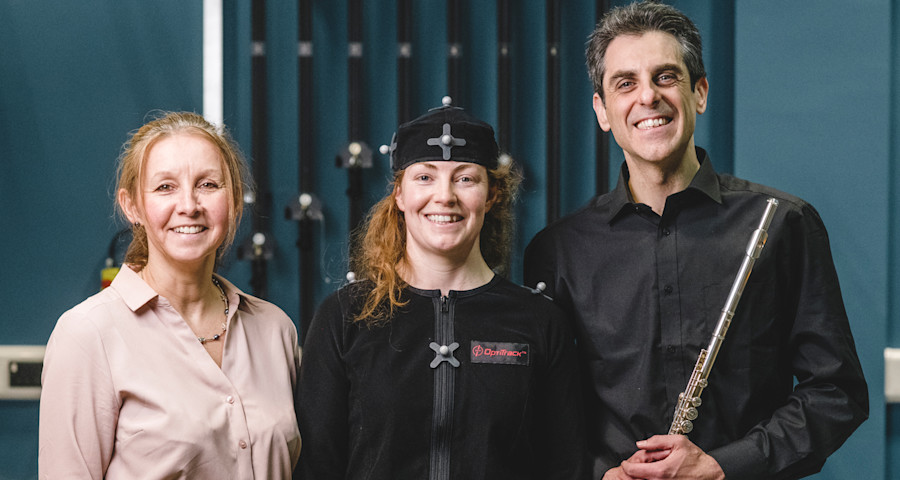
Musician and scientist Domenico Vicinanza has worked with organisations such as CERN and NASA creating music from scientific data. Always fascinated by how music and science are in a continuous quest for harmony, he is one of the pioneers of data sonification for scientific and artistic purposes. Since the end of 1990s he has supported scientists in different fields, from hydrobiology to cosmology, from earth science to particle physics providing, through sound, different perspectives to their data.
For his Creative Fellowship, Domenico explored research into movement coordination and changes in movement patterns during learning and over our lifespan. Based at our St Luke's campus, he worked with Dr Genevieve Williams and Julie Lewis-Thompson who are currently part of the team at VSimulators. VSimulators is a collaborative joint venture between the Universities of Exeter, Bath and Leicester, to develop facilities for multi-disciplinary research in human factors engineering, supported by an Engineering and Physical Sciences Research Council (EPSRC) £4.8 million infrastructure grant. Located at Exeter Science Park, the University of Exeter VSimulators facility can recreate any environment either physically or virtually, immersing up to nine research volunteers in a simultaneous experience.
Domenico explored data from this unique human-structure interaction, in order to create an engaging creative representation using sound. The fellowship sought to widen public engagement in the VSimulators project and human factors research, and create an enduring legacy of practice in this science field.
Discover more about how the fellowship unfolded in the below film.
"This collaboration aims to create music that will inherit the complexity, structures and unique properties of this one-of-a-kind infrastructure and its interactions with human movements. Working in synergy with the team of engineers and human movement scientists, this fellowship will continuously provide new perspectives into data and new opportunities for public engagement."
"The project will be enhanced through the perspective of a different lens. What are the creative outputs from such an experiment? How we can understand how sound, which is of course vibration, can be used to convey information about our vibrating platform? Can we learn about our platform from the creation and synthesis of sound?"
What does data sound like?
In December 2019 Domenico made his frist trip to visit the VSimulator at Exeter Science Park. Whilst there he took data directly from the simulator and translated it into an arrangement for a string quartet. Want to know how data sounds? Have a listen below.
Creating Music From Data - The Process
In early March 2020, we were lucky enough to see Domenico in action when he visited the VSimulators with Dr Genvieve Williams. We not only got to spend time witnessing how the VSimulators worked, but also the fascinating process of how Domenico went about collecting the data of its vibrations.
To help us better understand this process Domenico has created a downloadbale document to guide us through how he takes numerical data and translates it into a musical score, just like the one you can hear below.
Download Domenico's guide here.
Experimenting with Data and Sound
Using data taken from the same trip in March, Domenico also created three experimental pieces, extracting different parts of the data and interpreting them in three very different ways. Have listen below.
Piece 1
The first piece, VSims Continuous Flow, is based on extracting regular patterns from the waveform, mapping them to a music scale and sharing them between piano and harp, according to their characteristics and features. The piece has naturally some of the melody fragments flowing from one instrument to the other, played with their own pitch, timbre and rhythm. For Domenico this acts as a natural metaphor of the continual exchange between mechanics and music, art and science.
Piece 2
Called VSims Synergy, this experimental piece has been created by identifying individual musical notes from a recording Domenico did with a contact microphone placed on the vibrating platform. The collection of notes has been then played by a marimba and harp, orchestrated so that one was almost echoing the other, in a continuous dialogue between the two.
Piece 3
VSims Audio is an experimental piece about the richness of the vibrations; the complex waveforms captured by the sensors which have been filtered with special "harmonic sieves" looking for chords, melody fragments and harmonies. Domenico then arranged them together and added reverberation to create long sound tails. This is the most "organic" of the pieces and in some way the best one to communicate the smoothness of VSimulator and its majestic, elegant and fluid oscillation.
Play Data Yourself
Domenico has also made a musical score available to download and listen to. Taken directly from VSimulator data gathered during his last visit in early-March, it is suitable for those with ABRSM grade 1 or above. It has been recorded as a solo flute piece with piano accompaniment, however the score can also be played on guitar, piano, saxophone, clarinet and other instruments. So, why not give it a go yourself and play some data?!
Download the score here.
You can listen to the solo flute, piano accompaniment as well as the full track below.
Domenico had planned to play a selection of his data derived compositions live at the official opening of the VSimulator facility at Exeter Science Park earlier this year. Due to COVID-19 the launch event was postponed but undeterred Domenico adapted his original idea and brought together a virutal string quartet to play just one of the many pieces he had created.
Hear the results below.
University of Exeter
Room 153, Queen's Building
The Queen's Drive
Exeter EX4 4QH