In this fascinating article, MA Curation: Art and Business student Binjie Wang, explains the historical symbolism of colours in China.
Last week I re-watched the film The Last Emperor, a 1987 historical biographical film made in collaboration between Italy, the UK and mainland China. Director Bernardo Bertolucci adapted it from The First Half of My Life, the autobiography of the last Chinese emperor, Pu Yi.
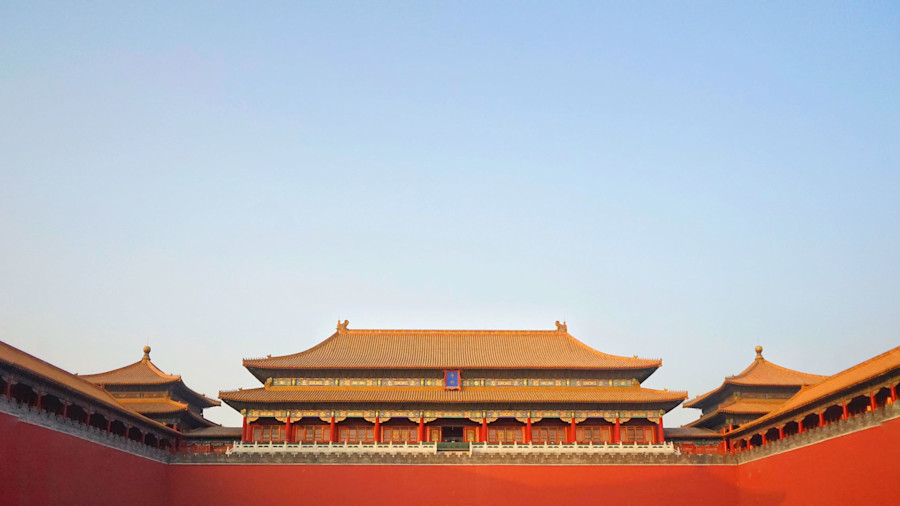
The Last Emperor is an excellent film, winning nine Academy Awards at the 60th Academy Awards, including Best Picture, Best Director and Best Adapted Screenplay. It is notable for being the first and only film in Chinese history to be set in China's 'Palace Museum' (where the emperors of ancient China lived and worked). On re-watching the movie, my attention was now focused not on the historical story but on the red walls, yellow roofs and the various traditional Chinese colours of the film.
The differences between traditional Chinese colours and European colours
When I think of European colours, I think of specific colours like red, yellow, blue, green and so on, and I know exactly what they look like and what the colours are. But when I look up the information about traditional Chinese colours, I see names like XUAN, PIAO, DAI (this type of colour is usually described by the feeling, without a specific colour card, even Chinese people would find it difficult know what kind of colour it is at first sight). Why does this happen? This is due to the different rules of the colour order between China and Europe.
Unlike in China, where the traditional starting point for colour is conceptual, the emphasis is more on the imagery of colour and the quest to express meaning with colour without a definitive concept. That is why ancient China did not use the elements of hue, lightness and purity to define colour but rather distinguished between positive colours (similar to Korean Obangsaek, which originated in China ) and intermediate colours (identical to secondary hues). The primary colours are the primary ones, like the three European ones.
But it is for this reason that the traditional colours of ancient China flourished so much. Comparing the numerous conventional Chinese colours and their names, I found the naming of antique Chinese colours fascinating.
Traditional Chinese colour nomenclature
In some ways, naming traditional Chinese colours is inseparable from literature. Plum white, mist white, pomegranate red, fallen leaf yellow, earthy yellow, sky blue and aquamarine, to name but a few, are all very traditional Chinese colours. To depict vividness, literature often coins many new words to express colours. For example, the colour 'East is White', which describes the dawn of day, comes from a poem by the ancient Chinese poet Su Shi. It represents a time when the sky is about to dawn but not yet fully lit, and the sky is blue with white, giving this colour a sense of the future.
There are hundreds of traditional colours in China alone. In addition to the above, the ancient Chinese liked to divide the same colour according to different styles. To indicate black with a floral pattern, there are "six recorded colours, which dramatically increases the number of traditional colours.
The meaning and significance of traditional Chinese colours
Internationally, most people think of the colour red when they think of Chinese colours. Indeed, as one of the earliest popular colours in ancient Chinese civilisation, red has permeated all aspects of Chinese life and has gradually evolved into a profoundly Chinese brand. The lipstick women use at weddings, the wooden red doors, the red walls of the Forbidden City, and the red lanterns at Chinese New Year——red is pervasive and ever-present in the Chinese world. Even in today's colourful age, the festive, reunion and vaguely imperial atmosphere revealed by red still commands attention and has become an eternal undercurrent of Chinese culture.
Red is inextricably linked to China through traditional and modern influences. Red is not just one colour in China; there are 70 different shades of red, in addition to the most authentic 'pure-red'. The most iconic of these is 'vermilion red'. This is a colour that lies between red and orange. This colour is derived from a mineral called cinnabar. When ground up and added to oil and water, it is transformed into a liquid or solid pigment for everyday use. The earliest use of cinnabar in China dates back to the ancient 'SHANG' dynasty (1600 BC-1046 BC). They were used to decorate bronze vessels and other ceremonial objects for rituals and significant events. It was more widely used during the 'ZHOU' dynasty (1046 BC-256 BC) when it was used to decorate the exterior of buildings and important places such as temples and palaces. During the 'HAN' dynasty (206 BC-220 AD), it was used to decorate royal tombs and other burial objects. This was because vermilion was believed to have protective properties against evil spirits and to ensure the prosperity of the deceased in the afterlife. During the ‘TANG’ dynasty (618 AD-907 AD), ‘MING’ dynasty (1368 AD-1644 AD) and ‘QING’ dynasty (1644 AD-1912 AD) dynasties, red was so closely associated with the power and authority of the emperor that vermilion was widely used as a decorative colour for imperial palaces and other official buildings to indicate the importance of the building. During this period, the high quality of Chinese vermilion was recognised worldwide and exported to Europe and other parts of Asia with foreign exchanges.
As well as being used in architecture, cinnabar is also used in painting and calligraphy. This pigment is made by grinding vermilion into a fine powder and mixing it with binders such as gum, egg yolk and vegetable oil. The resulting paste can be applied to paper or silk to create bright red images and characters highly valued for their beauty and symbolism.
The sense of history and Old-fashioned feel inherent in traditional Chinese colours is a unique aesthetic experience. Standard Chinese colours give the Chinese people the right to speak about Chinese aesthetics. The thousands of years of ancient Chinese wisdom and the beauty of the Chinese language are condensed in these words, which are an old tradition and hold the future of China, for it is the history of China and the confidence of the Chinese people.
References
Guo Hao, Li Jianming, "Traditional Chinese Colors: The Aesthetics of Color in the Forbidden City", ZHONGXIN Publishing Group, 2020
Huang Renda, "Chinese Colors", Jiangsu Phoenix Art Publishing House, 2020
Wiki
Baidu
University of Exeter
Room 153, Queen's Building
The Queen's Drive
Exeter EX4 4QH