This month we take a look at a remarkable embroidered tapestry entitled, 'Galaxy M81' by Mabel Early.
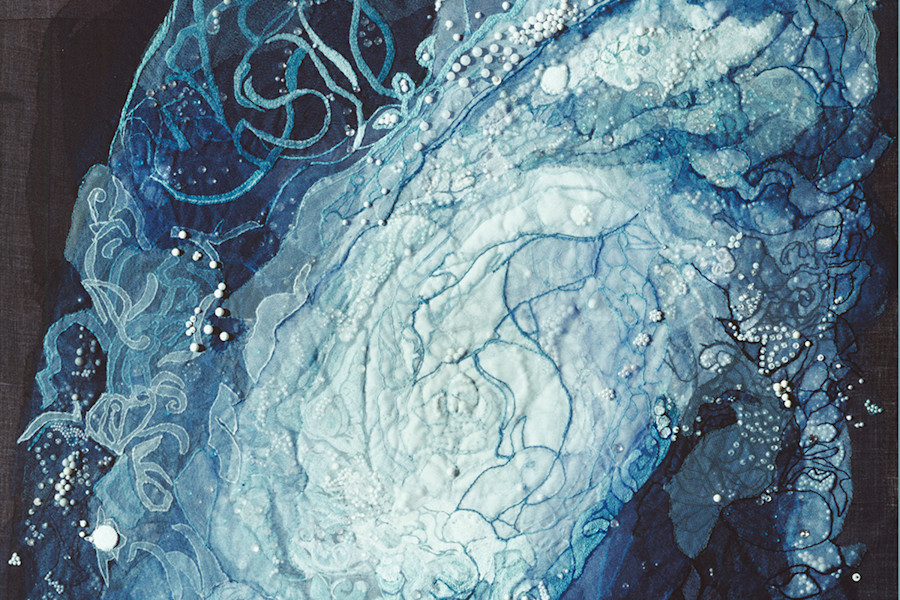
This month we take a look at a remarkable embroidered tapestry entitled, Galaxy M81 by Mabel Early.
Over 2m high, it evokes both a real and imagined galaxy, inspired by Galaxy Messier 81, which is situated 12 million light-years away in the constellation Ursa Major.
About the artwork
Following an exhibition of her work at the University in 1980, the University commissioned Mabel Early to create a wall hanging on the theme of astronomy.
She chose to create this large embroidered tapestry of a galaxy (a system of stars, stellar remnants, interstellar gas, dust, and dark matter bound together by gravity).
The work took Early five years to complete and it is made up from an array of materials, such as gauze, pearls, beads, glass, netting and fabrics. The result is a three dimensional, ethereal representation of this swirling star system, which was unveiled in the University’s Queen’s building in 1987.
About the artist
Mabel Early was born in Sheffield in 1910. Her father was a commercial traveller and her mother worked in retail; neither encouraged Mabel in her interest in art. Nevertheless Mabel showed an early aptitude for drawing and painting, which was nurtured by her art teacher at school, to the extent that she gained a place at the prestigious Slade School of Fine Art in London in the early 1930s. Further to this she returned to Sheffield to studied the design and making of dresses, and embroidery. Sketch books from those early days, which still exist, reveal her wonderful drawing and design skills. From people in cafes and public spaces, whose personalities she captured in a few lines, to repeat designs intended for fabric or wallpaper, to fashion designs – her sketches showed a breadth of artistic ability and inner drive to be creative.
Galaxy M81
Messier 81 (also known as NGC 3031 or Bode's Galaxy) is a grand design spiral galaxy about 12 million light-years away in the constellation Ursa Major. It holds a black hole 70 million times the mass of the Sun. One of the brightest galaxies in the night sky, it has been studied extensively by professional astronomers. The galaxy's large size and relatively high brightness also makes it a popular target for amateur astronomers. Messier 81 was first discovered by Johann Elert Bode on 31 December 1774. Thus, it is sometimes referred to as "Bode's Galaxy".
The image below gives a clue as to why Mabel Early might have chosen M81 as the inspiration of her work – it is enigmatic and beautiful. The NASA website describes Galaxy M81 as follows:
“The galaxy’s spiral arms, which wind all the way down into its nucleus, are made up of young, bluish, hot stars formed in the past few million years. They also host a population of stars formed in an episode of star formation that started about 600 million years ago. Ultraviolet light from hot, young stars is fluorescing the surrounding clouds of hydrogen gas. A number of sinuous dust lanes also wind all the way into the nucleus of M81.”
University of Exeter
Room 153, Queen's Building
The Queen's Drive
Exeter EX4 4QH