This month we feature an 18th century engraving of one of Devon's ancient buildings, by brothers Samuel and Nathaniel Buck.
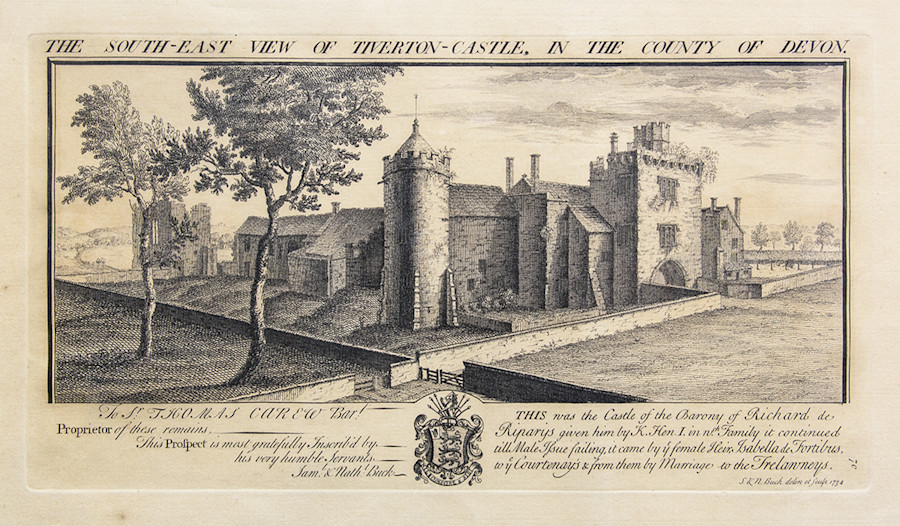
This month we feature an 18th century engraving of a Devon scene by Samuel and Nathaniel Buck.
About the engraving
This is a copperplate line engraving which was both drawn and engraved by brothers Samuel and Nathaniel Buck. It is dated 1734. The title of the work is The South-East View of Tiverton-Castle, in the County of Devon.
It forms part of their collection of engravings entitled, Buck's Antiquities or Venerable Remains of about four hundred Castles, Monasteries, Palaces, etc. etc., in England and Wales. This is a clear and simple view of the castle, almost an architectural record, rather than a work of art.
With its medieval origins, the engraving depicts a castle in slight disrepair, with buddleia bushes sprouting up from the ramparts. To the left of the engraving you can see the remains of the ‘Solar Tower’ which was built in 1308-9.
Beneath the engraving there is an inscription informing the viewer that the owner of the castle at the time of the engraving was Sir Thomas Carew, Baronet, together with a potted history of the ownership of the castle which states:
'This was the Castle of the Barony of Richard de Riparys given him by King Hen. I in which Family it continued till Male issue failing, it came by ye female Heir, Isabella de Fortibus, to ye Courtenays & from them by Marriage to the Trelawneys.'
About the Artists
Samuel Buck was born in Yorkshire in 1696. He successfully published a few engravings of ancient sites in that county, after which he moved to London to pursue his career as an artist and engraver.
It appears that he was a more prolific and well-known artist than his brother Nathaniel, although Nathaniel (whose birth date is not known), joined him in 1723, to start a systematic project to draw and engrave what would amount to a collection of over 400 views of ancient monuments, towns and sea-ports in England and Wales. Around 250 of these engravings featured castles, of which this example of Tiverton Castle, was one.
Each engraving would have been sold individually and collectors then bound groups of them together in books.
Their works were topographical, in other words they aimed to record accurately the physical features of the scenes they were drawing.
These views would have created a useful source for the study of historical sites by historians, at a time when photographs had yet to be invented. Indeed they formed the most comprehensive mid-18th century record of local scenes in England and Wales.
There were some criticisms of the quality of the engraving, but the Oxford Dictionary of National Biography published in 1886, notes of Samuel Buck,
“As a painstaking delineator of architectural remains long since destroyed Buck has never been surpassed for truthfulness of detail, often conveyed at the sacrifice of general effect.”
Nathaniel died some time between 1759 and 1774. Samuel died on 17 August 1779 in London. After Nathaniel’s death, Samuel focused on teaching, and drawing. It appears that he died in poverty.
Nevertheless the engravings of Samuel and Nathanial Buck are still of interest to collectors and historians alike.
Tiverton Castle
Tiverton Castle was originally built by Richard de Redvers on land given to him by King Henry 1. It remained in the Redvers family until 1293 when it was passed to a distant relative, Hugh de Courtenay of Okehampton who was later to become the 1st Earl of Devon. Tiverton Castle became the main residence of the Earls of Devon until 1539, when Henry de Courtenay was executed when he was suspected of taking part in a catholic rebellion. Tiverton Castle was then passed to various members of the nobility until it was eventually returned to the Courtenay family in the 1550s. It was later sold and made into a family home. By the time of this engraving, it was owned by Sir Thomas Carew, Baronet.
During the English Civil War, the Castle was a Royalist Stronghold and was attacked by the parliamentarians who destroyed its original medieval defences. Some evidence of the ruined defensive perimeter walls can still be seen today. The castle is now owned by the Campbell family and is open to the public.
Acknowledgements
Revolutionary Players: https://www.revolutionaryplayers.org.uk/samuel-and-nathaniel-bucks-views-of-ruins-of-castles-abbeys-in-the-midlands-1726-1739/
Castle Studies Group: http://www.castlestudiesgroup.org.uk/Antiquarian%20Prints2-Buck-50-57.pdf
University of Exeter
Room 153, Queen's Building
The Queen's Drive
Exeter EX4 4QH