This month we feature an impressionistic watercolour painting by Nathaniel Hughes John Baird, depicting Exeter Quay at a time when it was still a working quay.
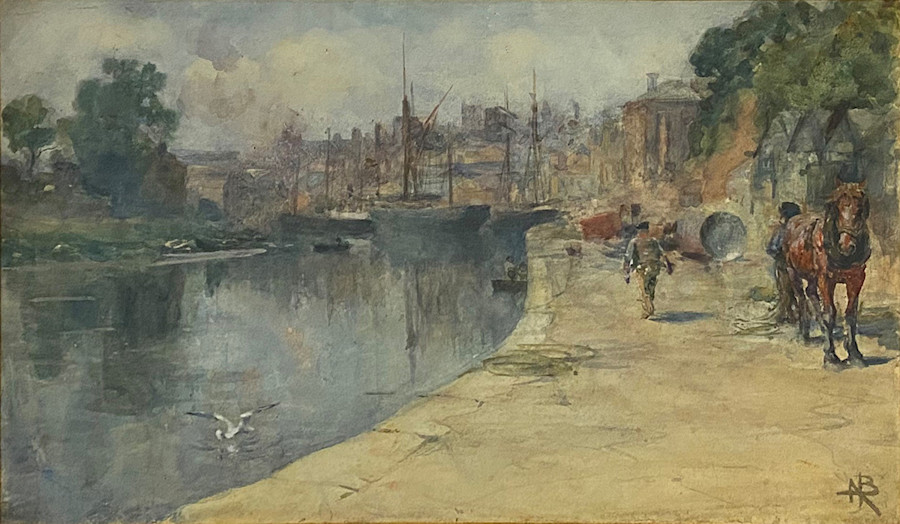
This month we feature a fine watercolour painting depicting Exeter Quay, probably painted in the early 20th century by Nathaniel Hughes John Baird (1865 - 1936).
About the painting
This painting depicts Exeter Quay when it was still a ‘working’ quay, when boats arrived carrying goods from overseas. No doubt the working men and the solid working horse in the foreground were employed in unloading goods and carrying them up into the city and beyond.
Much of the view is recognisable today, from the storage cellars on the right, to the tall warehouses beyond. There may be some artistic licence in the painting, as what may be the cathedral, can be seen between the masts of the two ships, on the skyline. In reality the cathedral cannot be seen from this perspective.
The style of the painting is quite loose, which gives it a feeling of movement. The sky is grey and cloudy and the buildings are quite gloomy, evoking a sense of an ordinary working day, rather than a romantic depiction of the waterway and quay.
Although somewhat impressionistic in style, the artist adeptly captures the stillness of the river and the proportions of the horse.
About the artist
Nathaniel Hughes John Baird (1865-1935) was born in Yetholm in Roxburghshire. He first studied under his father and then at the Coldstream Academy, Edinburgh, then went on to study in London and later Paris.
His work was accepted into the Royal Academy Summer exhibitions between 1883 and 1935 and he exhibited at many of the principal galleries including the Royal Institute of Oil Painters of which he was elected a member in 1887.
He painted in both oil and watercolour, He favoured equine subjects, especially heavy horses at work, so it is no surprise to see a horse in the foreground of our painting of Exeter Quay.
He moved to Dawlish in Devon in 1880. One of his most notable commissions was from the Miller family of Torquay to paint a portrait of their young daughter Agatha, who later became Agatha Christie.
Around the time of his wife’s death in 1918, he is recorded as living in Topsham near Exeter and following the death of his wife he moved to Sussex and then finally to Oxfordshire before his death in 1935. Perhaps this painting of Exeter Quay could have been executed in 1918-19 when he resided in Topsham, which is in close proximity to Exeter.
About Exeter Quay
In Roman times, the River Exe was navigable as far as the Quay and there is evidence that goods were loaded and unloaded just beneath the Roman Wall. In the 13th century Countess Isabella de Fortibus had a weir built across most of the river above Topsham, so that she could run her mills on each side of the river. (Hence the name ‘Countess Wear’ we know today.).
The river was completely blocked in the 14th century by Hugh de Courtenay, ensuring that boats had to load and unload in Topsham, which was under his control. When in the 16th century the weirs were removed, it was found that they had completely silted up the river meaning it was not navigable. This led to the construction of a canal, updated in various forms over the centuries, to link Countess Wear to the City, to once more enable access to Exeter’s Quay.
The Quay flourished over the following centuries, and you can still see the brick customs house today, which was built in 1680. However, with the advent of the railway, the need for transport by boat diminished and the area declined. Most of the Quay has now been regenerated and is a great destination for leisure activities. Find out more about the history of Exeter Quay on the Exeter Memories website.
Below is a photograph of the quay as it is today.
University of Exeter
Room 153, Queen's Building
The Queen's Drive
Exeter EX4 4QH