How do you create a unique musical score from numbers and graphs? 2019/2020 Creative Fellow Domenico Vicinanza tells us more about working with Dr Genevieve Williams and the team at VSimulators in helping to bring this state-of-the-art research platform to life through music.
Domenico Vicinanza is not only a musician, he's also a scientist. Having previously worked with organisations such as NASA on sonifying the sun rising over Mars, he is no stranger to turning data into music.
He has been collaborating with University of Exeter academic Dr Genevieve Williams and the team from VSimulators, a new state-of-the-art research platform, to explore turning its vibrations into a unique musical score.
But how do you turn numbers and graphs into a melody? Below he guides us through the process and lets us listen to the final result.
Step 1 - Collecting the Data
The starting point for any sonification is the acceleration. It is measured using special sensors called 'accelerometers' placed on the vibrating platform.
The sensors pick up the accelerometer measurements which are then collected as a series of numbers. Their evolution, changes and progression, describe the way the VSimulators oscillate.
__Step 2 - Representing the Data __
A graph is probably the most common way of representing data. The one below to the left is the accelerometer measurements from VSimulators.
However, there are many ways we can represent data other than a graph. To create music from measurements we need something that associates sound to data, for example, a rule that maps numbers to music notes.
Step 3 - Creating a melody
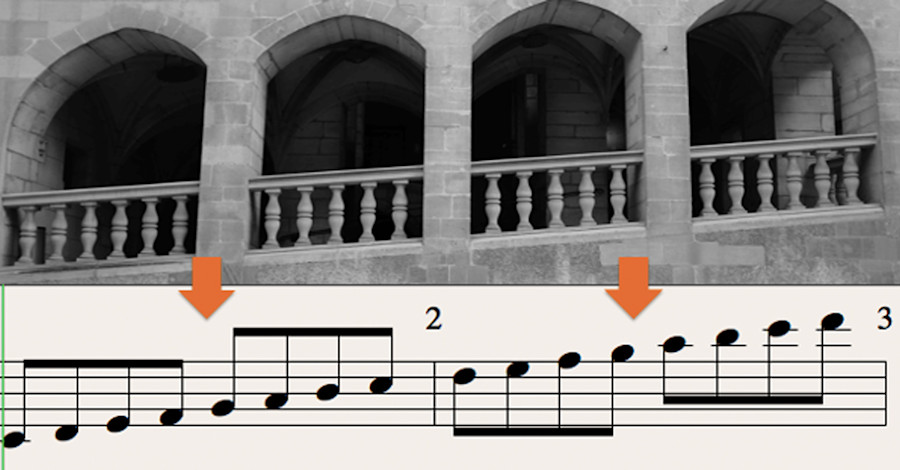
By mapping numbers to music notes you can quite naturally start to create a score and a melody is born. Below you can see how the melody shape follows the profile data.
Intervals between numbers can become notes...
Step 4 - Let's listen to the data
The final result is a musical score that can be played by musicians. The excerpt below is of the accelerometer measurements shown above played on harp. The melody is moving smoothly up and down, following the smooth vibrations of the platform.
But how can hearing, rather than simply seeing, the data help the VSimulators team? Domenico tells us:
I firmly believe that music is a precious conduit to naturally convey not only the regular vibrations, the visible oscillations, but also the hidden structures, the secret patterns, to a general audience. I hope music will help to make VSimulators and human movement sciences accessible and enjoyable for a larger audience, raising awareness about the way, not only researchers and scientists, but all of us, interact with the different and ever evolving environments around us.
You can find out more about Domenico's Creative Fellowship 'Human Movement: Translating Data into Art' by clicking on the 'Related Content' link below.
University of Exeter
Room 153, Queen's Building
The Queen's Drive
Exeter EX4 4QH