This month we focus on a bronze bust by sculptor Drago Marin Cherina, of Elizabeth Collard, a trailblazing female journalist who actively promoted understanding of contemporary issues in the Middle East.
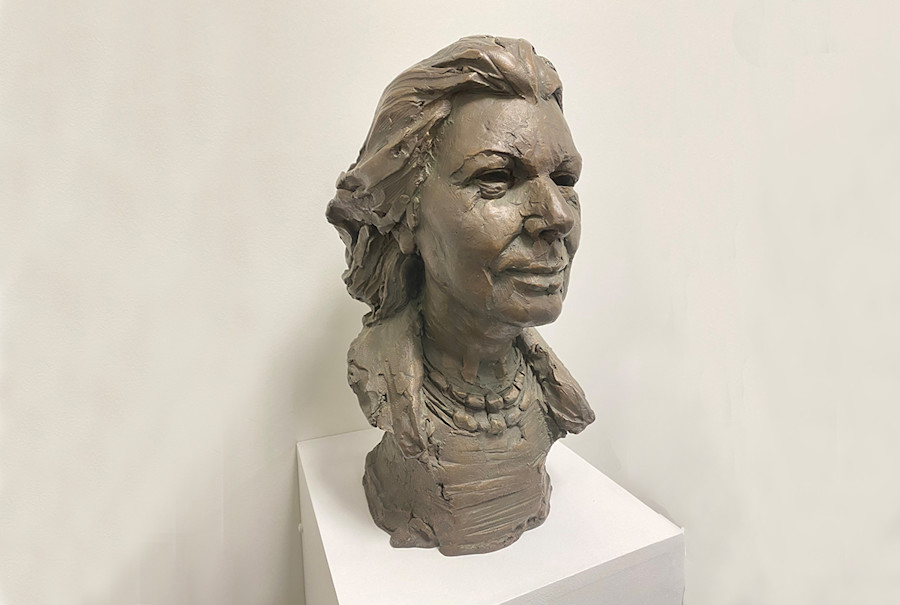
This month we focus on a bronze bust by sculptor Drago Marin Cherina, of Elizabeth Collard, a trailblazing female journalist who actively promoted understanding of contemporary issues in the Middle East.
About the Sitter
Elizabeth Collard, the subject of this sculpture, was born in Koltata, India in 1911. Her first school was in Darjeeling, India, which she attended until 1920; she then completed her education in England, achieving a Diploma in Social Sciences at Bedford College, London, followed by a first class degree at the London School of Economics in 1935. Her father died in 1930, so the latter part of her education was self-funded.
At an early age she took up cause of anti-imperialism and was an early member of the India League, an English organisation which campaigned for Indian Independence, founded by Krishna Menon in 1928, later becoming its vice-chair.
She is recorded as being the President of the Universities Labour Society, leaving that role to take up the post at the age of 23 of International Secretary to the first World Youth Congress in 1936. She was tasked with organising the congress, which was an offspring of the International Federation of League of Nations Societies, itself designed to exchange ideas, educate on international cooperation, and promote action to prevent war. She was joined in her work with Michael Wallace, son of the British Author Edgar Wallace, who was to become her first husband.
Michael Wallace died whilst on active service during World War II, in 1944. In 1948 Elizabeth married Dudley Collard, a prominent radical barrister and writer on law in the Soviet Union. He represented the Communist Party of Great Britain as a lawyer.
After the war Elizabeth joined the economic department of Reuters news agency. It was then that she became aware of the lack of balanced and accurate information on the Middle East. In 1957 she founded the Middle East Economic Digest (MEED), a publication which remains an authoritative source of information on the Middle East today. View the MEED website here.
As well as her publishing, writing and business activities, Elizabeth Collard was actively involved in a variety of political, economic and cultural Anglo-Arab associations, such as the Council for the Advancement of Arab-British Understanding, of which she was a founding member, and societies promoting the cause of the Palestinian Arabs.
An important figure in promoting better understanding of the Middle East by Western Countries, she counted many of the Middle East's leaders and leading thinkers - including Gamal Abdel Nasser of Egypt and King Hussain of Jordan - among her friends in the region. And in the UK, the prime minister James Callaghan said of her when she died in 1978, “Her work, both for the Party and on the Middle East scene, was very widely appreciated and we shall miss her greatly."
On her gravestone is inscribed, “ ‘Journalist, Anti Imperialist”.
About the artist
Drago Marin Cherina (b 1949) is a Croation-born sculptor, who in the 1970s decided to become a naturalised Australian, following a commission to sculpt a bust of the then Australian Prime Minister, Gough Whitlam. He now lives in Taiwan.
About the artwork
This sculpture dates to 1974. It is understood that Elizabeth Collard was a friend of Oscar Nemon, sculptor and mentor of Drago Cherina, which may be how Cherina was introduced to her.
Cherina reminisced that, "Mrs Collard was very smart, she did not like to speak much, but her sentences carried much weight in a very few words."
The sculpture appears to reflect Elizabeth Collard’s personality – she looks directly at you, friendly but firm in expression. The artist has used bold markings to create a feeling of strength and liveliness.
The Elizabeth Collard Collection at the University of Exeter
The Elizabeth Collard Collection is held in the Arab World Documentation Unit (AWDU) at the University of Exeter.
Donated to the University in 1982 (after Elizabeth Collard’s death) the archive comprises over 40,000 documents, including archives of the Middle East Economic Digest (MEED) from 1969 onwards, and documents annotated by Elizabeth Collard herself.
Acknowledgements
-
Peter Mansfield: Bulletin (British Society for Middle Eastern Studies), Vol. 6, No. 1 (1979), pp. 78-79 (2 pages) https://www.jstor.org/stable/194374
-
Find a Grave website: https://www.findagrave.com/memorial/74681333/elizabeth-katherine-collard
-
Wikipedia
-
Ancestry.co.uk
-
Newspapers.com
-
Dr James Downs : Archivist (Middle East Collections), AWDU Librarian and Project Manager of DAME (Digital Archive of the Middle East), University of Exeter
University of Exeter
Room 153, Queen's Building
The Queen's Drive
Exeter EX4 4QH