A spotlight on one of the 12 artists/art collectives showing work as part of the Environment and Sustainability Institute (ESI) Creative Exchange exhibition 'Catalyst'. In this blog Dr Sarah Chave and Dr Alison Harper share more about their work and the Japanese art of Momigami.
Alison Harper is an artist and activist and Sarah Chave is a teacher and researcher. They are both based in Bath, UK, and met during their respective PhDs when they discovered shared concern for issues of sustainability. Alison’s work interrogates relationships with the material world we so often take for granted. She believes a disassociation from the qualities of matter can only lead to a disconnection from an understanding of the forces and qualities that make us human. Sarah has taught in and researched adult and higher education for over 30 years. In Sustainable and Democratic Education: Opening spaces for complexity, subjectivity and the future (Routledge 2020) she troubles Western conceptions of education and argues for ways in which education can ‘enlarge the space of the possible’. We continued to develop ideas during our Environment and Sustainability Institute’s (ESI) Creative Exchange collaboration Deep materialism and caretaking: a study of material relationships for the 21st Century.
Our work invites embodied creative entanglements with the natural world of which humans are a part. Its intention is to disrupt accepted framings of the biosphere and to encourage enchantment and deeper relationships with all life, all matter so that they become closer to us, are seen as a part of us and open up a sense of renewed caring and a desire to challenge and alleviate harms inflicted by many humans on our shared planet.
To encourage involvement with matter we introduced the Japanese art of Momigami to participants at various events during our collaboration.
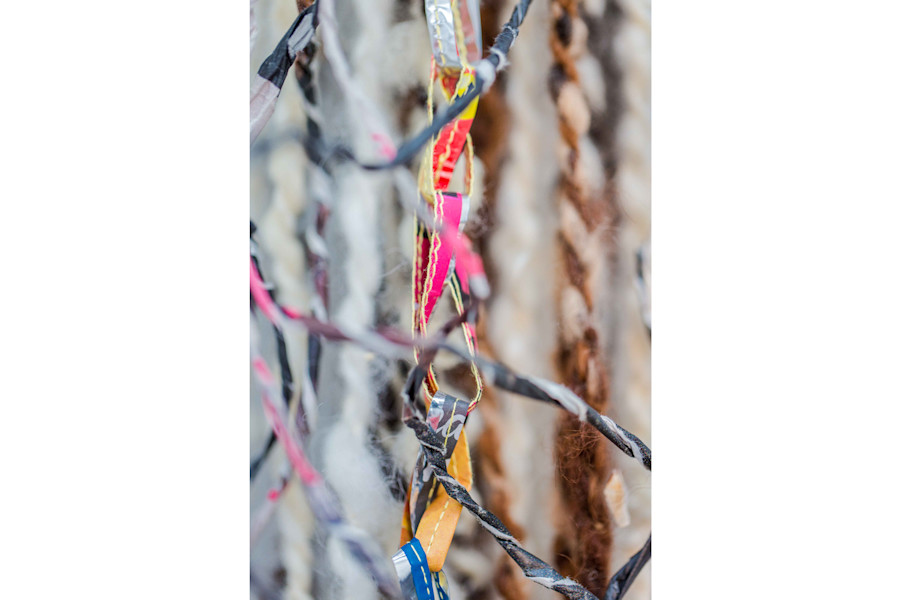
The process is simple, accessible and involves a repetitive act of crushing, crinkling then smoothing the paper which both breaks down and also thickens the fibres. The paper gets smaller. The process produces something counterintuitive. The ‘momi’d’ paper is soft, appearing fragile but has an unseen, unacknowledged strength. What is undone to some extent is the industrial process that the material has gone through: it is the hand un-made. The relationship is altered, it is re-made as is the paper. Using the hands to bring the material (back) into the possession/context of the human reveals qualities of the material previously unseen.
Momigami was central to the virtual webinar event we facilitated on 30th November 2020. The event created two virtual collaborative collages which explored and celebrated how whilst we cannot touch other humans we can still touch, appreciate and learn with and from materials with which we are entangled. Touch and Entanglement in a Time of Coronavirus - Momigami is an entanglement of particpants’ Momigami and some of their reflections (which they shared in the zoom comments box) on participating in this process.
The second collage created at the workshop Touch and Entanglement in this time of coronavirus: Commotion can be seen in Catalyst. It stands alongside two further works Stanley and the Slug and Enchanted Forest. These artworks in Cataylst are our invitation to you to reflect and to open pathways for developing more ethical, caring relationships within our shared planet.
About Catalyst
Showcasing nearly a decade of arts/science collaborations at the the University of Exeter's Environment and Sustainability Institute, Penryn, 'Catalyst' features new work by twelve artists, all of whom have previously worked with researchers as part of the ESI Creative Exchange. You can enter the virtual gallery by clicking on the image below.
University of Exeter
Room 153, Queen's Building
The Queen's Drive
Exeter EX4 4QH