Graffiti artist Cinna Solar has recently been collaborating with University of Exeter PhD student, Gemma Lucas and paper botanical artist and Exeter alumna, Bee Watson on an arts project exploring intersectionality, mental health and creative practice. Below Cinna shares with us what motivates her creative practice and process.
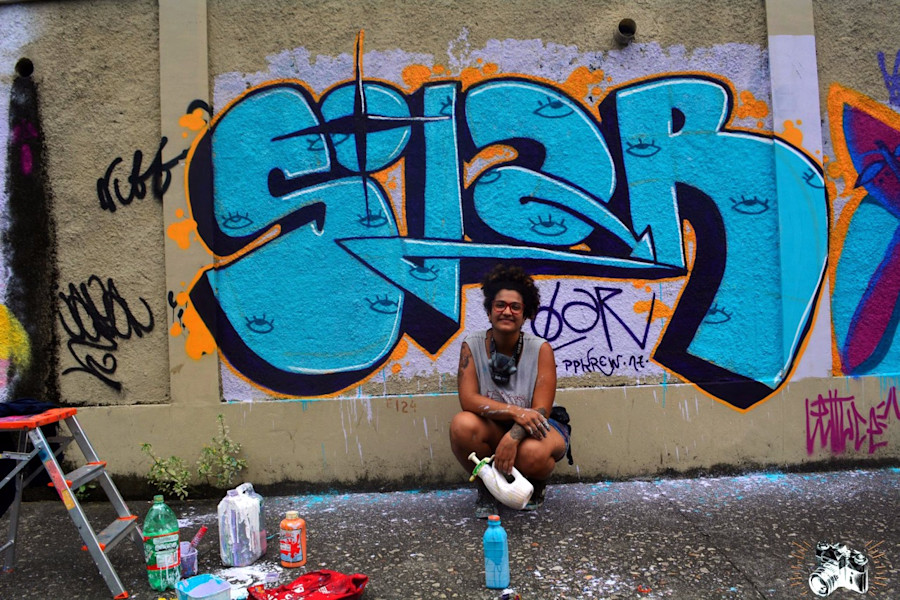
I started practicing art not long ago. Until I was 24, I couldn’t draw a circle. Then graffiti entered my life, and everything changed.
When I say everything, I mean it. My view of life changed, my political perspectives changed, my physical disposition changed. I had a huge change at my formal job, my interests at Uni changed, the way I connected with people and the things I liked… it all changed. Graffiti brought me opportunities that I would never get in my “normal” life. It allowed me to access previously closed off places, it took me to all around my city, places I would never go by myself. And then again, graffiti brought to the surface things I wasn’t aware of or I chose to ignore. And it did all of this because of the people I got close to. It was because of the close contact with them and because I was open to receiving it, that all of this could happen.
Since 2018 I've been part of the CASA Collective, which works with children of the poorest favela in Rio: the Aço Favela. There, I had the chance to plant seeds, water them and see them grow.
Soon after, I started to work with social projects: first with black women and then with children. I was always giving workshops and involved in some kind of project. All of these projects arose through contact with the graffiti artists themselves. There was always someone in a favela that would organize paintings and we would all gather there. Together with the crew I was part of, I organized monthly reunions to gather and exchange with other graffiti artists from the whole city. Again, contact.
Since 2018, I've been part of the CASA Collective which works with children living in the poorest favela in Rio: the Aço Favela. There, I had the chance to plant seeds, water them and see them grow. Being with the kids at least once a month for two whole years brought me so close to them that soon enough I was not just a teacher, I also became a role model, an example of how art can bring us far if we dedicate and believe it.
Art for me has been a contact sport not just because it demands my body to be there, because of the physicality of the practice, but also because it provides me with opportunities to empathize, to be like-minded with so many people I’ve met, to create connections, to plant the seeds and cultivate them.
During the Artists' Residency we’ve been talking a lot about creative process and how things start. Now I see that my process is actually a series of triggers, created and ignited by things that sometimes are just random and that click with another thing I saw, read, heard, touched before. The focus of this blog post, that ‘art is a contact sport’, is one example of how this has happened during the residency. At one point I was painting a canvas and I got some paint on my hands. This paint on my hands ignited memories of me coming back from so many graffiti paintings with my hands, glasses and clothes covered in paint. It also reminded me of the times I would retrun from the workshops with kids and have marks of their hands on my white shirt. I would always be physically close to my friends whilst painting which meant I could learn from them, enjoy their company. Contact, but not only being physically there: being connected.
Art for me has been a contact sport not just because it demands my body to be there, because of the physicality of the practice, but also because it provides me with opportunities to empathize, to be like-minded with so many people I’ve met, to create connections, to plant the seeds and cultivate them. I see them rooting at every encounter and growing strong when watered with tears of pain and laughter, nurtured with quality time and good food, I see them blossoming as the years pass by.
Contact with other people, places and things make me into a different person, everywhere I go. I’m a different person in the different languages I speak. I’m a different person when I’m back home and when I’m not.
All of these things have been in my mind for a while, but connecting with Bee and Gemma during the Artists' Residency has given me the sense of being heard and hearing, as well as feeling empathy. I am currently based in Berlin, but even with the many kilometres of distance between us, I could start stitching together the threads of these memories, creating all of these remembrances into one big piece that makes sense as a whole
These different types of contact and connection change me. Contact with other people, places and things make me into a different person, everywhere I go. I’m a different person in the different languages I speak. I’m a different person when I’m back home and when I’m not. I’m read in a completely different way depending on the person who reads me, and there’s nothing I can do about it. I am many.
One of the things Bee said to us during the residency was about a person she met, that said “My life is so much bigger than my words”. My life is so much bigger than my words too. Why would I want to reduce something so big to something so small?
Now I can understand which things and feelings ignite my creativity, and because I’m multiple, I have the need to express myself in multiple medias. I started with writing, came to graffiti, went to acrylic painting, to digital art, photography, audio-visual. I’m a passionate Librarian. I’m a business woman, a leader, a teacher, a friend, a daughter, a sister. I’m a person within many. I change and I adapt.
One of the things Bee said to us during the residency was about a person she met, that said “My life is so much bigger than my words”. My life is so much bigger than my words too. Why would I want to reduce something so big to something so small?
University of Exeter
Room 153, Queen's Building
The Queen's Drive
Exeter EX4 4QH