This month we feature 'Clovelly by Moonlight', a plein air watercolour painting by Italian artist, Cesare Formilli, who settled in London in the 1890s and found a connection with the Newlyn School of artists.
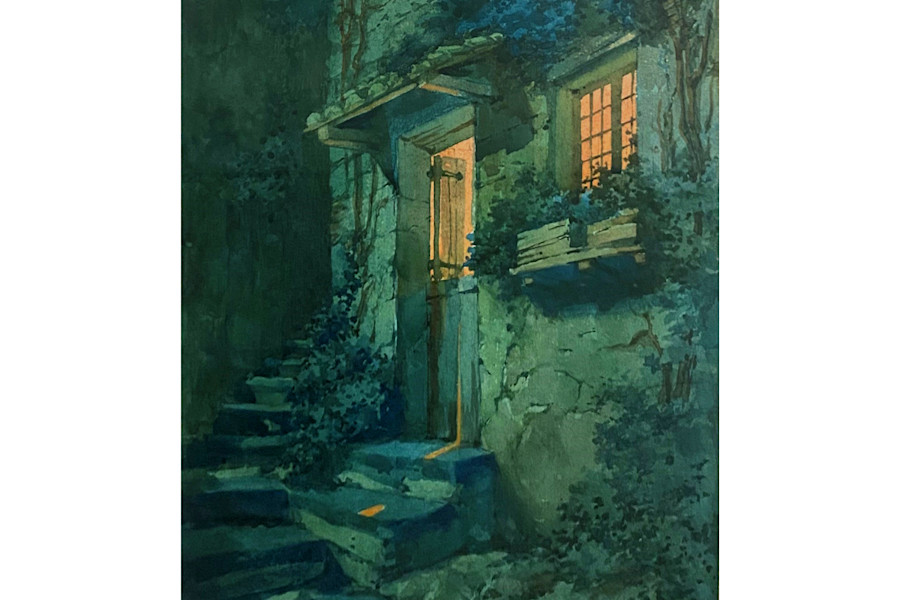
In this article we focus on the watercolour painting Clovelly by Moonlight, a plein air painting by an Italian artist, Cesare Formilli, who settled in London in the 1890s and who made connections with the Newlyn School of painters.
About the painting
This unusual watercolour was painted by artist Cesare Formilli, in 1906. It depicts a scene from the North Devon fishing village of Clovelly. What makes the picture out of the ordinary is that it is a night-time scene. Probably painted ‘en plein air’, with the artist working in situ, in the dark, it shows us an aspect of this well-known tourist attraction that not many people would see.
About the Artist
The artist Cesare Formilli was born in Rome in 1860. He was an illustrator, accomplished watercolourist and designer.
He was part of a late 19th century artistic movement in Italy which rejected the formal ‘academic’ style of art typified by works submitted to the Italian Gallery of the Exposition Universelle in Paris in 1878, preferring to depict a more natural representation of the world.
In the late 1890s, Formilli moved from Italy and took up residence in South West London. This is possibly because in 1889, he married a British woman so decided to live here. He continued to build his artistic practice, with records showing that he exhibited his work in the Royal Academy Summer exhibitions several times at the end of the 19th and beginning of the 20th century.
Possibly due to his track record in painting ‘en plein air’ he was invited to Cornwall by the Newlyn School of artists who also favoured the immediacy of painting outside. This must have been when his connections with the West Country were established.
Two works by Formilli depicting Clovelly, which is just north of the Cornwall boundary into Devon, were published in the Illustrated London News in June 1896. He clearly enjoyed painting Clovelly, as he must have returned to paint the watercolour we are featuring, which is dated 1906.
One of his Cornwall paintings, featuring a blacksmith’s shop with the title, Closing the Link was shown at the Royal Academy in 1899.
Formilli was somewhat of a polymath – as well as being a painter, he was also a member of the Royal Pastel Society, exhibiting in their exhibition of 1900.
In addition, he created artwork and designs on a larger scale, involving different mediums. In 1897 he was commissioned to carry out the interior design and decoration of a new dining room at the Walsingham House Hotel in Piccadilly. He also painted frescoes in the Catholic Cathedral of St Anne in Leeds and designed the pulpit and carried out mosaic work on the walls of the Brompton Oratory.
His practical and engineering skills were also brought into play when was commissioned as the Engineer for the Italian building at the 1915 Panama-Pacific International Exposition in San Francisco. Passenger records show him visiting the United States in 1914, presumably to plan this project.
Cesare Formilli continued his artistic practice from his base in London, where he died in 1942.
Links with Italy
Records show that despite living in England, Formilli retained his links with Italy, and his homeland retained high regard for him.
Acknowledgements
The Internet Archive
Ancestry.co.uk
Gale Primary Sources
Wikipedia
The Decoration of Brompton Oratory Church 1928-32 by Peter Howell.
University of Exeter
Room 153, Queen's Building
The Queen's Drive
Exeter EX4 4QH