University of Exeter, Art History and Drama student Grace Abercrombie shares with us more about her time working as a Social Media Content Creator for the National Youth Ballet's 'All In!'programme earlier this year, which explores how ballet can be taught in a more inclusive way.
When witnessing dance, a translation is inherent in the form. Movement, even at its most narrative, is abstraction. This is its beauty.
When witnessing photography, the transformation from reality into art is less apparent. Photographs are deceptive, appearing to quote absolute truth; in actuality, they depict the photographer’s subjective perspective. The framing is chosen by an unseen figure, just as the content of a dance work is chosen by its choreographer. Both dance and photography are curated.
Both dance and photography are translated. Images and movements, when taken/performed by different artists, are always distinguishable; different translators produce different translations. In classical dance, the distinguishing features of dancers are all but eradicated, to create a corps de ballet – all of the same height, build, technique. This produces a certain traditional beauty, in some eyes. The underside is ugly.
Ballet has historically condemned originality. The body as instrument, and more insidiously as aesthetic, is consistently praised. An exclusive industry easily becomes exclusionary: the racialised, queer, and disabled body is ostracised as Other.
This is not to say the industry refuses change outright. Progress is occurring, with specific organisations at the forefront.
National Youth Ballet is a British charity providing young dancers the opportunity to take to the professional stage. Performers work with industry choreographers, pulling together a range of dance styles into anthology ballets which showcase the skill and creativity of the company’s young artists. The organisation has received praise Sir Matthew Bourne, and counts among its alumni professional choreographers, actors and, naturally, dancers.
More recently, National Youth Ballet has translated its art into a new form, now mediated through lens, rather than Proscenium Arch. NYB has taken one small step for the single dancer, and one giant jeté for aspiring performers across the country: they’ve taken their choreography to The Big Screen.
There is nothing like the way a dancer’s face lights up when you take their picture at the right instant.
When you, as photographer, catch the retiré or line of the eye, or even just that decisive, creative moment when the light comes through the studio’s windows, reflects in the mirror and catches the performer, just as they fall into the choreography’s rhythm.
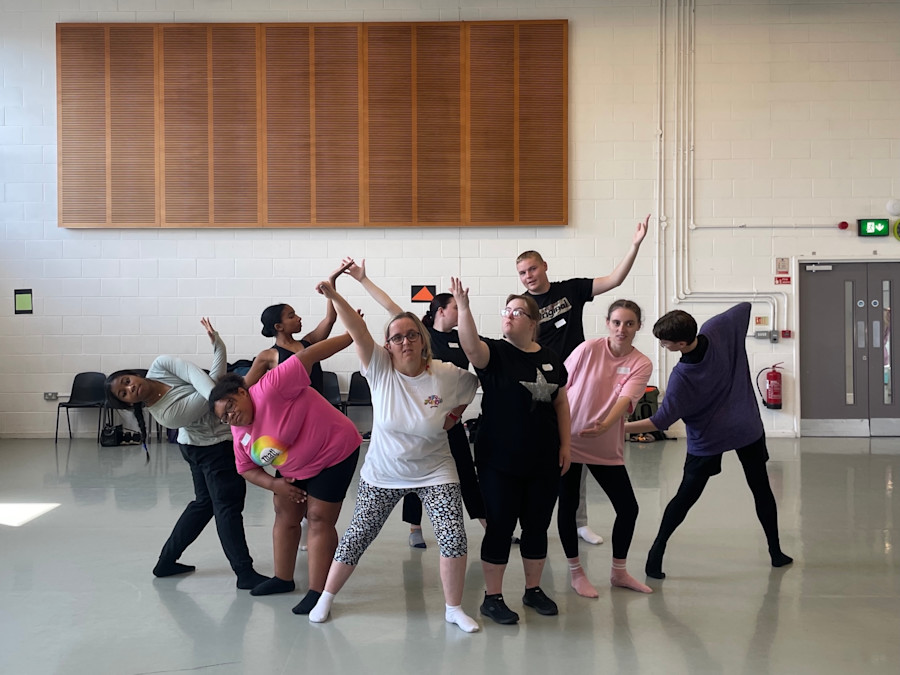
NYB All In!, for both myself as a neurodivergent individual, and others in the studio, was intuitively a safe space. This is not often the case in this industry; one feels one must cling to camaraderie if and when one finds it. We rehearsed for only a short time, but when those around you love what you love, and love it so deeply that there is not a semblance of the jealousy that pervades our craft, the glass-in-the-pointe-shoe cutthroat stereotype is deconstructed. Dance demands the artist become familiar with their fellow performers. NYB All In! was the first time I have watched a cast become family.
I was honoured to bear witness to and document such boundless creativity.
In the imagery captured I finally saw a healthy dance space materialise. Here were dancers creating movement for a Cinderella in which her transformation post-ball, back into her true self, was not portrayed as a setback, but a triumph. This was a ballet celebrating its cast’s individuality, their joy.
A true corps. No two dancers alike, but inspired and supportive, moving as one body, translating movement between them, just as the choreography was committed to and changed through the lens I operated, and later, at the castle, that of the cinematographer. This was, however inadvertently, an effusion of the plurality of movement. Of art itself.
Disabled/neurodivergent performers deserve a space in this industry that has so long ridiculed and demonised us. We deserve to be seen, on the stage and screen, on gallery walls, in positions of authority. National Youth Ballet gave me this.
Ballet cannot afford to languish in conservatism; the idea of a singular “canonical” method of ballet dancing is a fallacy, serving a bigoted ideal. To dance is human, and ballet’s beauty comes in its multiplicity, just as the beauty of humanity comes in our diversity.
So see us.
University of Exeter
Room 153, Queen's Building
The Queen's Drive
Exeter EX4 4QH