On the 250th anniversary of the birth of JMW Turner, we take a look at some of the engravings in the University of Exeter Fine Art Collection, created from Turner's sketches.
The 23 April 2025 sees the 250th anniversary of the birth of JMW Turner, often considered to be Britain’s most celebrated artist of the 19th century. Known for his watercolours, prints and oil paintings, Turner’s style developed throughout his career; at first creating works with a romantic quality but later moving to a style which would, decades later, be termed as Impressionism.
Turner is renowned for his shimmering depictions of light and colour, using subtle changes in hue rather than defined lines or contours, to capture moments in time. He is perhaps best known for his atmospheric paintings The Fighting Temeraire and Rain Steam and Speed - The Great Western Railway, which both exemplify his impressionistic style.
Engravings
So how did Turner, with his impressionistic style, and love of use of subtle light and colour, fall into print making, a medium which requires hard lines and mark-making in black and white? The first thing to consider is cashflow. Like everyone else, Turner had to make a living. Imagine creating a masterpiece in oils – this would be an in-depth project taking several weeks or even months to produce. The price commanded for a large oil painting would mean that it was only available to a wealthy clientele, so an artist could wait a long time to make a sale.
However, printing, before the days of photography, was a way of reproducing an image many times over at a greatly reduced price. It was also a way of promoting the visibility of an artist by making their work widely available. Selling multiple copies of an artwork provided the possibility of a regular income.
Thus Turner was involved in several print projects throughout his career. From the 1790s until his death in 1851, nearly 900 engravings after his work were published.
In some instances, Turner was commissioned by engravers to make watercolour sketches for turning into prints, and in others Turner instigated or partnered on printmaking projects with engravers. However, as we shall see below, not all his commercial ventures brought the income he hoped for.
University of Exeter Collection of Prints after JMW Turner
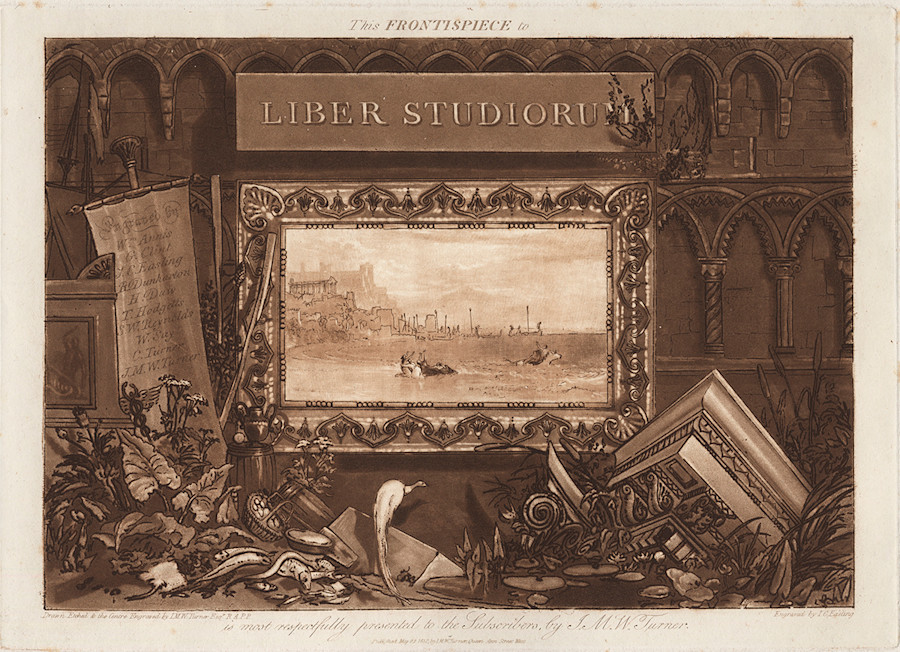
The University of Exeter is fortunate to have, in its Fine Art Collection, around 600 engravings of work based on sketches by Turner. Some of these are published ‘states’ of the engravings and others are working proofs (ie at a stage still to be completed for publishing). The collection principally consists of engravings from the series Liber Studiorum (1807-1819), Cooke’s Picturesque views on the Southern Coast of England (1814-1826) and Picturesque Views in England and Wales (1827-1838), with examples from other series also represented to a lesser extent.
Liber Studiorum
Cooke’s Picturesque Views of the Southern Coast of England
For this venture, Turner was commissioned by engraver William Cooke to sketch a series of coastal scenes from Kent to Somerset, from which he, his brother George Cooke and other eminent engravers could execute a collection of high-quality engravings. It was agreed that Turner would be paid for 40 sketches at £7.10s for each sketch. Cooke indicated to Turner that if successful, they could follow this project with another series featuring views of the Northern Coast. However, the Southern Coast series took twelve years to complete (1814 – 1826) and Turner and Cooke eventually fell out over Turner’s remuneration, and never worked together again.
Picturesque Views in England and Wales
Pope’s Villa
One of the most interesting groupings of engravings after Turner in the University’s Fine Art Collection is the series of printer’s proofs of the engraving, Pope’s Villa at Twickenham. It was executed by the engraver John Pye in 1809, after a sketch by Turner, commissioned by publisher John Britton.
If you look closely, you can see the progressive iterations of the engraving, the 'engraver's proofs', as the engraver adds more to the image, finally achieving the version which was published.
Acknowledgements
-
Google Books
-
Professor Sam Smiles – Emeritus Professor History of Art, University of Plymouth. Honorary Professor, Art History and Visual Culture, University of Exeter
-
Wikipedia
If you are interested in finding out more about the University’s collection of engravings after Turner, please do get in contact with Arts and Culture by emailing artsandculture@exeter.ac.uk.
University of Exeter
Room 153, Queen's Building
The Queen's Drive
Exeter EX4 4QH