This month we feature a sculpture titled 'Kay Alexandra' by Witold Gracjan Kawalec. The work, acquired by the University in 1979, exemplifies the artist's interest in creating sculptures from Alabaster, which is known for its translucent quality.
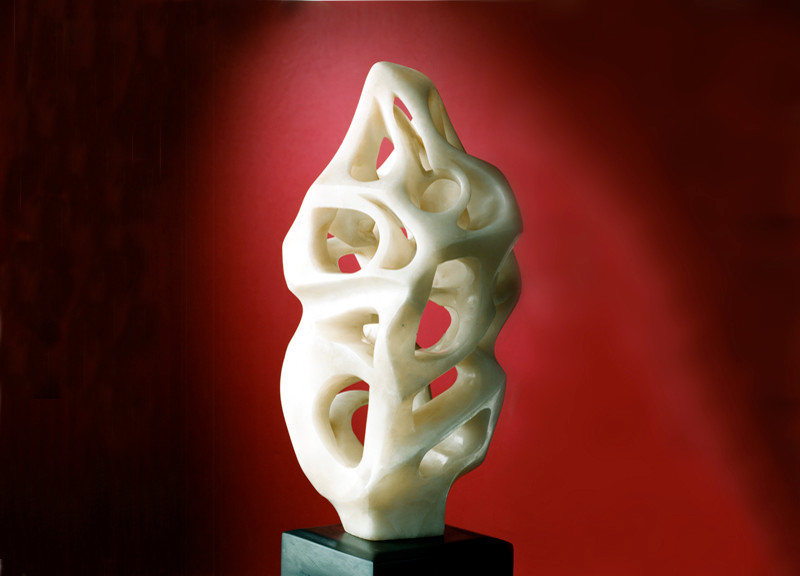
This month we feature a delicate alabaster sculpture titled Kay Alexandra by Witold Gracjan Kawalec.
About the sculpture
Kay Alexandra was created to celebrate the birth of the sculptor’s grand-daughter. It is compact in design and the many graceful concave and convex curves reveal an intricate variety of gentle perspectives which catch and absorb light.
It is designed to be viewed from all angles, and the translucency of the alabaster means that the sculpture changes according to light levels. This tight, enclosed, space with the complex sculpted design ‘inside’ the form, is typical of Kawalec’s work. Perhaps it represents the complexities of our inner selves. Or maybe it reflects the artist's own description of his work as being 'poetry in carving'.
About the Artist
Born in 1922 in Vilneus, a city then in Poland, Kawalec was the son of a diplomat. He first studied sculpture in Poland under a private tutor. In World War II he joined a Polish army unit and saw active service in North Africa, most notably in Tobruk, Libya. In 1942 he was accepted for training with the Royal Air Force, serving from a base in Nottingham and then posted to 307 fighter squadron in Exeter.
After the war he studied sculpture at Nottingham College of Art and became a visiting teacher there. He opened his first sculpture studio in Nottingham in 1953 and so began his professional career as a sculptor. He often worked in alabaster, which could be sourced locally in the [Nottingham] (https://en.wikipedia.org/wiki/Nottingham_alabaster) area.
His work was influenced by his wartime experiences – many of his works are abstract and appeal to the human emotions. Some of his most notable figurative sculptures have a religious theme. His best known work is the sculpture of St Christopher carrying Christ across the water, on the outer wall of St Christopher's Hospice in Sydenham, London. Several of his pieces were made for churches, including in 1966 carvings for the top of the pillars in St Aidan’s Church Basford, in Nottingham, representing Work, Peace, Mercy, Hope, Life, Guidance, Humility, Justice, Grace and Music and later on a wooden statue of St Boniface in Crediton Church.
During his career, he had many one-man exhibitions and also exhibited a work at the Royal Academy Summer exhibition in 1959. In the Nottingham Evening Post of 25 August 1970 can be found an article promoting an exhibition by Kawalec. It gives us clues as to the inspiration for his works:
Sculptor’s fame is spreading
*Nottingham sculptor Witold Kawalec is working on a large sculpture ‘Flame’ which will incorporate a live flame in its structure, in preparation for a major exhibition of his works in the ruins of Coventry Cathedral next June. *
The inspiration for this work seems to stem from a significant moment in Witold’s life when, on staring at a piece of flaming wood in a fire, he decided to begin his work as an abstract sculptor.
Since then he has been given numerous one-man exhibitions throughout the country. His most recent show was in Lincoln in June, where his work attracted the attention of Dame Sybill Thorndike.... Witold feels that people can best appreciate his work by touching it and he will encourage this at his Coventry exhibition.
In 1976, Witold Kawalec moved to Devon with his wife, where he created a public sculpture garden in an orchard near Crediton and encouraged and passed on his skills to younger artists.
The University hosted an exhibition of his work in 1979, when this sculpture was purchased.
Witold Kawalec died in 2003.
Kay Alexandra can be seen as part of the University's public Sculpture Walk which is free to visit.
References
-Tate Library Catalogue, Item ID 22442, 'Kawalec, Witold Gracjan'
-The Times, Jan 22 2004, Lives in Brief, Witold Gracjan Kawalec
-Nottingham Evening Post and News, August 25 1970 (via British Newspaper Archive)
University of Exeter
Room 153, Queen's Building
The Queen's Drive
Exeter EX4 4QH