Arts and Culture has brokered a new partnership between Arts & Heritage and the University of Exeter's Centre for Magic and Esotericism.
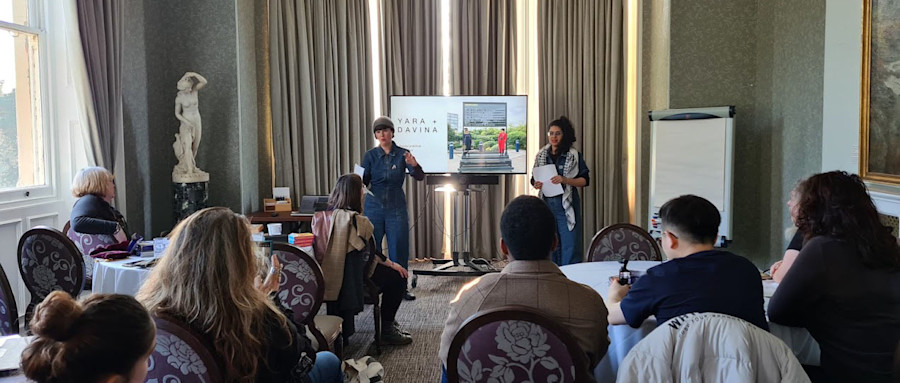
Our team often meet with academics to learn about their research, and with artists to learn about their creative practices - we look to make introductions that will hopefully spark future collaborations. In this instance, Arts & Heritage were working with artist duo, YARA + DAVINA, to build on their highly successful ORACLES card deck and accompanying readings. For this earlier project, the artists had undertaken a series of community workshops to develop a deck of 33 cards, each one responding to a painting in the Dulwich Collection and offering an accompanying prompt.
Conventionally, oracle card producers create set meanings for cards and then illustrate the cards accordingly. For ORACLES, YARA + DAVINA turn this approach on its head by working with pre-existing images to find meaning. The outcome is a set of cards that offer thoughtful provocations for self-reflection, and that become activated and dialogical when people bring a question to the cards. The cards can be read on their own, or in addition, the artists can offer live Oracle Card reading sessions. These intimate, honest and profound conversations happen when people make creative leaps between what they see in the cards and their own lived experience.
Arts & Heritage (A&H) is a national commissioning agency that fosters connections between artists, historic sites, museums, and communities. They aim to challenge and reimagine the creative exploration and interpretation of heritage. The ORACLES model that YARA + DAVINA have created offers rich potential to re-examine cultural heritage, and surface amazing treasures held in archives and collections. Stephanie Allen, Director of Arts & Heritage, is working with the artists to identify future iterations of the ORACLE, applying the model to different contexts across England. Was there an opportunity to connect with Exeter?
When the university launched an MA in Magic and Occult Sciences in 2023, it made headlines from the BBC to the New York Times, and was greeted with curiosity, excitement, and a fair dose of misunderstanding. Countering any sensationalism, the course content summarises the focus on “magic in Greece and Rome, occult texts in Judaism, Christianity and Islam, the history of witchcraft, magic in literature and folklore, deception and illusion, and the history of science and medicine…”, as well as specifying that “we place the Arabo-Islamic cultural heritage back where it belongs in the centre of these studies…”
Emily Selove, Associate Professor in Medieval Arabic Language and Literature at the university’s Institute for Arab and Islamic Studies, and Convenor of the Centre for Magic and Esotericism, designed the MA to showcase the unique, interdisciplinary expertise of our colleagues in the study of the history of magic. YARA + DAVINA were aware of Emily’s amazing work, and keen to build links with the university, especially as Yara had relocated to Exeter. Emily was excited to connect with Arts & Heritage and the artists as the ORACLES format presented new methods, not only of communicating research outside of academia to members of the public interested in magic and divination, but also of enriching research through these conversations. More specifically, exploring the potential for a collaboration would allow Emily and colleagues to tap into the University's magic and occult archival holdings, both as scholars and historians of these documents, and as humans in dialogue with the wider community and with the hidden mysteries represented by the documents themselves.
With support from the Arts and Humanities Research Council Impact Accelerator Account (AHRC-IAA) Translational Fund, we have been able to run a short project to start building a new partnership. This generous support allowed YARA + DAVINA to spend time with Emily and colleagues in the Institute for Arab and Islamic Studies, to explore the university’s Special Collections and Archives, skilfully guided by Dr James Downs, Archivist of the university’s Middle East collections, and Librarian for the Arab World Documentation Unit, and to run workshops with MA students to trial the methodology in a different context.
We have achieved all our primary objectives – to consolidate conversations into a partnership, to provide time and support for the artists to become more familiar with the archives and meet researchers, and to test the workshop model and establish interest and motivation for further engagement with publics. In Arts and Culture, projects like this are what we live for, and the positive feedback from both the partners and participants has been very inspiring. We are looking forward to the next steps and will share updates.
University of Exeter
Room 153, Queen's Building
The Queen's Drive
Exeter EX4 4QH