In this specially written blog, University of PhD Researchers Shibani Das and Rebecca Howarth share with us more about their 'Researchers Wellbeing Through Arts' project, a space that bridges academia and creative arts.
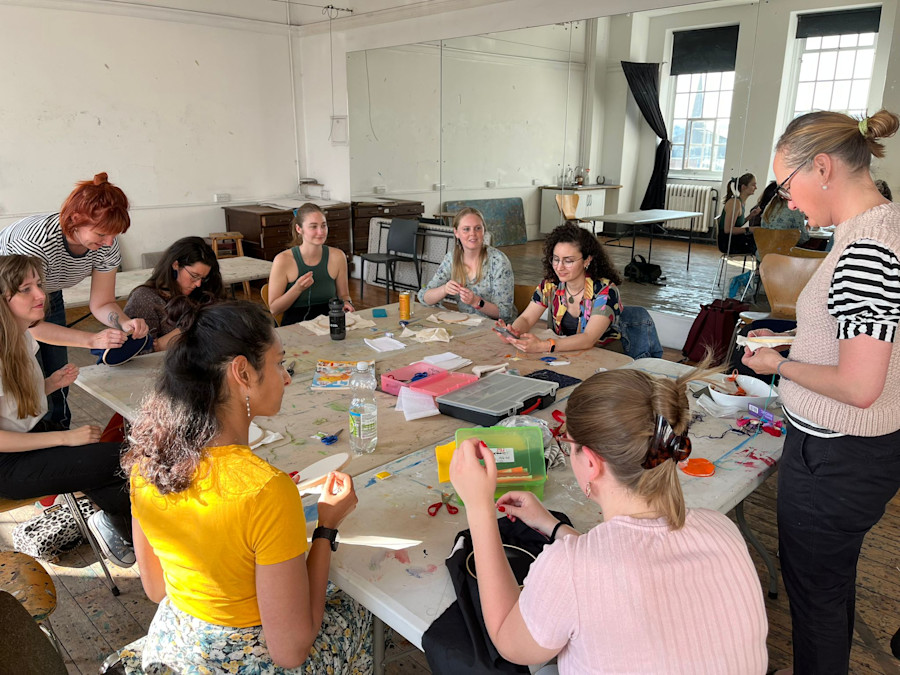
As we walked past Sidwell Community Centre one wintery morning, coffees in hand, hearts satiated and brains buzzing, little did we know that a casual discussion about how we’d ideally imagine our doctoral practice would become a 2-month-long funded project that would span across four forms of art, nine strains of research specialisation, nineteen hours of art, and uncountable memories.
Last year, we became close friends, bonding over the difficulties of being PhD students and our love for all things creative. Throughout our friendship, we have shared skills and used arts and crafts to care for our mental wellbeing, explore our creativity, and navigate the ups and downs of being young women in a profession that is intellectually and psychologically gruelling.
We eventually wondered if other students in the city might be struggling just as we are and might benefit from a platform that celebrates their creativity, intellectual ability, and desire for social interaction. The resultant leap of faith and the Researcher Led initiative Award application thus gave birth to the Researchers Wellbeing Thru Arts project, a space that bridges academia and creative arts.
Through this project, we aimed to give PhD students the opportunity to engage with the challenging parts of their research through arts and crafts. We wanted to create a supportive community of PGRs who could discuss the difficulties of undertaking a PhD, the challenges of their research, and the impact this has on our mental wellbeing. We wanted to bring these students together, off-campus, engaging them in the local community, away from the constraints of separating disciplines and offices. We saw longevity in this project. Knowing the positive impact creative arts have had in our lives, we hoped to gift the participants with confidence and skills in art forms they could continue to explore after the project's end.
The Project
The project included four introductory sessions in which facilitators introduced participants to four art forms: printing, fabric arts, clay, and painting/drawing. Each session focused on confidence-building and equipping the participants with the basic skills of the craft as well as processes and the experience of the art rather than the output or end product. With Simon Ripley from Double Elephant, the participants were introduced to layers in printmaking and the process of organically creating work through each layer. With Mattie Richardson from Bunyip and Molly Rooke from Darn Good Studio, a focus on darning and fixing what’s broken stood out; making art intentional and weaved into the everyday as well as connected with sustainability and environmental concerns. Our last facilitator, Sarah John, gave us confidence in exploring shapes and working on larger scales with both clay and painting/drawing. Following the taught sessions, we had two independent sessions for the participants to work on a piece of art, inspired by one or more of the facilitated sessions, which engaged with their research. We are currently curating an exhibition to showcase these artworks, as well as the project in its entirety, to be held at the Positive Lights Projects on June 29, 2023, from 6-8 pm.
The Impact
We have learned a tremendous amount through this project, and it has given us an immense sense of pride and confidence, which we did not expect. To see a project come to life, from those first abstract discussions between close friends over crafting, to a fully curated exhibition and a supportive community of PGRs has been an honor.
We are grateful to our participants who, from the first introductory session, were open and vulnerable about their feelings of isolation and doubt during their research. Through this project, we have seen the prevalence of feelings of isolation in PhD students. Isolated by a multitude of factors such as strict disciplinary spaces, immense screen time, and the separation between campus and the local community. The project has been truly interdisciplinary, and it has been a delight to see PGRs from Humanities and STEM brought together and bridge this disciplinary divide in academia. By being completely off-campus and integrated into the local community in Exeter, the connections we have made with the local craft scene in Exeter are another beautiful legacy of this project. It has been incredibly rewarding to see an increase in confidence in our participants, a confidence to speak up and out.
But we think the most rewarding aspect of this project is to have seen this community of PGRs blossom into a group of close friends. All passionate about creativity and all from different disciplines and areas of research, bonding over creative arts. Instead of being isolated and stuck behind our screens, we were brought together, using our hands to create art. This project has really given us all a safe space to explore the messy parts of our research, the contradictions, and challenges, without the pressure of a looming end goal and the need for perfectionism. We would love to see more projects that connect creative arts with research for both the benefit of the research and the benefit of looking after our PGRs.
As we open the doors to our final exhibition at the Positive Lights Project on June 29, 2023, at 6 pm, we close a chapter that is months in the making. While we hate to see this project come to an end, it is with great pride and love that we showcase all the hard work that our doctoral students and facilitators have put into their art and all the love and encouragement we have received.
Interested in knowing more?
If you're a PhD researcher at the University of Exeter and would like to know about potential future creative workshops or meet ups then please contact Shibani Das on sd720@exeter.ac.uk or Rebecca Howarth on rh769@exeter.ac.uk
University of Exeter
Room 153, Queen's Building
The Queen's Drive
Exeter EX4 4QH