This month we are focusing on the original of an illustration for the Graphic Magazine, entitled, "Royal Enclosure, Ascot", by Frank Craig (1874-1918).
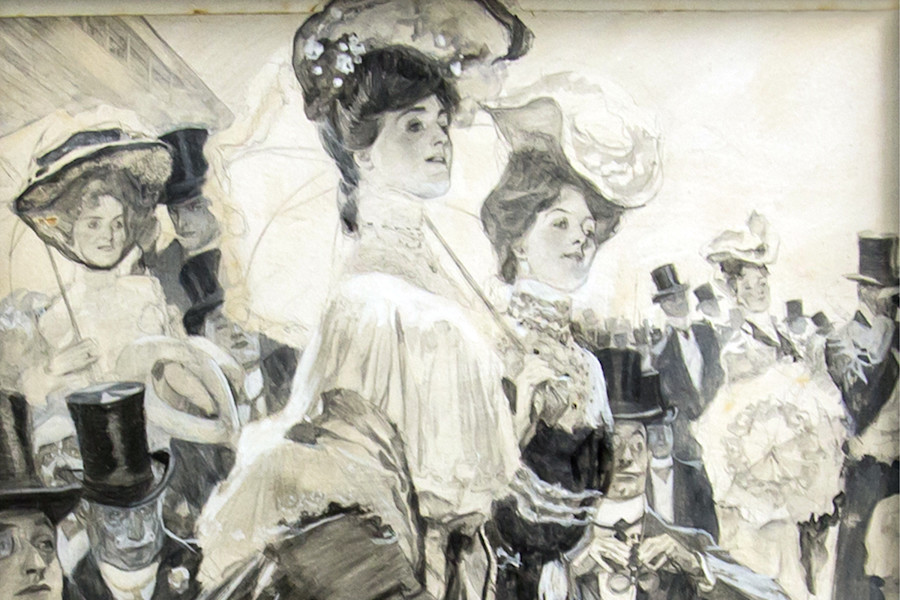
This month we are focusing on the original of an illustration entitled, Royal Enclosure, Ascot, by Frank Craig (1874-1918).
About the picture
This picture is created in mixed media - ink, wash and graphite on paper, and is dated 1905. It featured in The Graphic, an illustrated weekly newspaper of the time that covered popular social events, such as this scene of people enjoying horse racing at Ascot. Photographs were not as common as today, so illustrations would have played an important role in visually conveying to the population what the most fashionable women were wearing.
The black and white image has a strong sense of design, with the slats of the bench on which the central character stands, drawing the eye up through the details of her outfit. The wide-brimmed hats of the period are used as a design-element to give the image form. The women portrayed have a confident air, perhaps pertaining to the fact that they are aware of their status in the ‘Royal Enclosure’. Perhaps they are straining their necks to get a view of the horses on the track, above the crowds.
The illustration is monotone as The Graphic was only printed using black ink. This work was published in its edition of 23 June 1906.
About the artist
Frank Craig was born in Bexley Heath, Kent, in 1874. He aspired to be an artist from an early age, even telling his school friends that he wanted to study at the Royal Academy Schools (RAS). He left school at 14 and unfortunately failed his first attempt his first attempt at gaining a place at this prestigious institution. He enrolled at Lambeth School of Art and was later successful in becoming a student at the RAS in 1895, the same year he first exhibited a work in the Royal Academy Summer exhibition. He would have been aged 21 at this time.
Another of his early aspirations was to be an illustrator for The Graphic magazine, an ambition which was also realised in 1895. He was a dedicated and hard-working artist and he also began to work for other magazines, such as Harper’s, the Pall Mall Magazine and the American periodical Scribner’s.
As well as being a ‘society’ illustrator, he also illustrated books and stories, completing ten illustrations to accompany Arthur Conan-Doyle’s works between 1898 and 1901, and Rudyard Kipling’s fantasy book Rewards and Fairies(1910), amongst others.
Paintings
Frank Craig was also an extremely competent painter in oils. Many of his paintings had medieval or fantasy themes. He was clearly influenced by the Pre-Raphaelite aesthetic, with his works sometimes containing a hint of Arthur Rackham, the children’s book illustrator.
A major influence on his work was also the work of Edwin Austin Abbey, his mentor at the Royal Academy Schools.
His paintings featured in the Royal Academy Summer exhibitions between 1895 and 1916 and were clearly highly regarded by the art world.
Frank Craig’s dedication to his practice eventually proved detrimental to his health. In the early 1900s he had already left London for the fresh air of Surrey. Eventually his output began to drop, even though his work was still much respected.
He passed away at the early age of 44, suffering from tuberculosis.
Today, Frank Craig is not a well-known artist perhaps because most of his outputs were in the form of illustrations, which do not give an artist as much visibility as one who holds exhibitions and is known in the art world. Yet his work is worthy of note, with his strong sense of design and competency as a painter.
Family and Connections
Frank Craig married Katherine Moser in Marylebone in 1898. Around 1900, they moved to Surrey from London and there they had two children, Frank Barrington Craig, in 1902 and Leonard Desmond in 1908.
Their first son, Frank Barrington Craig, became a well-known artist who taught at St Martin’s school of art. He was a friend of Walter Thomas Monnington RA who designed the ceiling of the Mary Harris Memorial chapel on the Streatham Campus.
The 1911 census shows a boarder at the Craig’s house in Ewhurst, Surrey, namely the artist Leonard Campbell Taylor. He was a well-known artist who went on to be an official war artist in WW1. He was clearly a friend of the Craig family.
Acknowledgements:
Ancestry.co.uk
The Arthur Conan-Doyle Encyclopedia
The Royal Academy of Arts Archive
The British Newspaper Archive
The Graphic, April 4 1925, Article by Mr Frank Rutter
Google Arts and Culture
University of Exeter
Room 153, Queen's Building
The Queen's Drive
Exeter EX4 4QH