Ahead of the launch of Pharmakon at the University of Exeter, artists Still/Moving invite us into their world to learn more about the scientific inspiration and creative process behind the new sculpture.
Excited to see the sculpture? Join the unveiling event on 14 June at 4pm outside Geoffrey Pope building on the University Streatham Campus.
Ahead of the launch of Pharmakon at the University of Exeter, artists Still/Moving invite us into their world to learn more about the scientific collaborations and creative processes behind the new sculpture.
Commissioned by The Medical Research Council Centre for Medical Mycology (MRC CMM), Pharmakon will highlight the use of science to tackle the global burden of human fungal diseases.
__Excited to see the final sculpture? Join us for the Pharmakon Unveiling Event on 14 June at 4pm outside the Geoffrey Pope Building (Streatham Campus). __
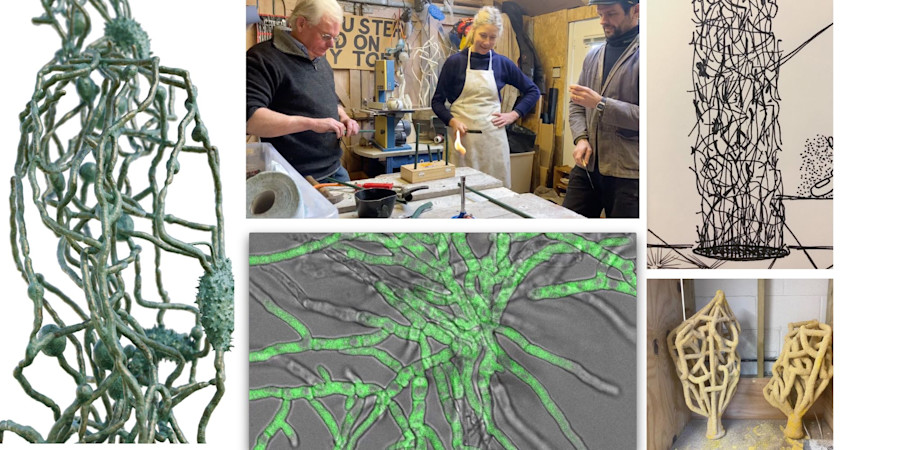
In December 2021, Still/Moving won a commission to build a permanent sculpture outside the MRC Centre for Medical Mycology on the campus of the University of Exeter to commemorate the groundbreaking, but often hidden research into pathogenic fungi taking place within the institute. When we read about the commission, we were in the fortunate position that Léonie Hampton, one of the three members of Still/Moving, was coming to the end of an artist in residency at the MRC Centre, and was brimming with ideas, images and concepts that she had amassed during her time working with the scientists. We were particularly inspired by microscopic film footage of fungal hyphae growing within host tissue; the filaments spreading, branching and interweaving as they seek out nutrients. We drew particular inspiration from imagery of Candida aurus, Candida albicans and Aspergillus fumigatus.
We were also fascinated by footage showing how human white blood cells called macrophages (extraordinary shape-shifting forms) seek and attempt to consume intruding yeast cells, in a complex dance that is constantly taking place within our bodies, but that we are mostly unaware of. We wanted to make visible this precarious inter-relationship which treads the fine line between a healthy host and one that may succumb to disease.
From Still/Moving’s previous work concerning de-colonisation, we were particularly interested in the way in which we talk and think about the immune system, the host and the pathogen. We want our work to help dispel the militarised language often surrounding self in battle with the ‘other’. “The immune system is not just a war machine, as many still tend to think it is… Humans are not little states with their own border patrol but assemblies in a web of life.” (Rupa Marya and Raj Patel) Rather than continue the idea of the immune system as a colonial apparatus, we are interested in the notion that immunity is a process of negotiation and damage management. Fungi can become us, a part of who we are.
We decided to make the human host invisible, but present in a form that the hyphae trace, and that defines the silhouette of the sculpture. Within this form imagined as a cylindrical laboratory core sample, taken from a host, fungal hyphae could explore and grow. This vertical column would take the traditional proportions of classical and figurative sculpture, to bring to human scale an imaginary journey of fungi, as it seeks out resources and avoids regions of scarcity.
Having been shortlisted on the basis of some preliminary sketches and descriptions of the concept, we worked with Roland Woolner, the director of Neon Productions, and an extremely talented digital artist, to develop a 3D model to visualise the concept. The digital renderings he created were so realistic that not only did they convince the panel, but many asked if we had already made the work in bronze.
During our successful interview we explained that we had never worked with bronze before but we were confident there were experts who could help us realise it within the 6 month timeframe demanded by the brief. If not we were in trouble!
We had many conversations with foundries around the country and it became clear that we had two options. Either to 3D-print a version of Roland’s model in a plastic that would then be cast directly into bronze, or learn to work with wax and make the form by hand ourselves, from which a bronze cast could be taken. 3D printing at such a large scale is still very expensive and problematic, and we really wanted the physical and tactile relationship to the sculpture that wax offered. It was a wonderful opportunity to learn about new mediums.
We eventually found a wonderful small foundry called Phoenix Art which was happy to mentor us through a journey with wax, teaching us the basics of how to fuse elements together, create moulds with silicon, and manipulate rods or ‘sprues’ of wax into complex forms.
With some basic skills under our belt, we spent several weeks prototyping the hyphal strands that would be the principal component. We imagined visitors to the sculpture would want to touch and explore them with their hands and we wanted them to look and feel as close to those in the electron microscopy images that we had studied.
We settled on a process of casting highly textured lengths of wax in silicon moulds which we then dipped in hot wax, using a special vertical water bath we had made. This created a thin mottled, highly organic texture on the surface.
The macrophages had to be hollow to be cast in bronze, so once their shape and surface texture was resolved by hand-forming in modelling wax, they had to be ‘slip cast’ in silicon moulds to create the correct wall thickness, too thick and they would crack.
To help decide the overall form of the sculpture that the hyphae would collectively describe, we made a series of small clay maquettes, progressively carving out pieces from a cylindrical column, intuitively seeking a vertical form with a curvaceous and undulating outline. Once we found and agreed on one, we scaled it up, cutting out its negative shape from cardboard panels to create an outline within which we could build.
With all the building elements now ready, the making of the final sculpture was a relatively quick process. We had batch produced a set of strands which could be warmed to around 40ºC in a water bath to soften them enough to manipulate but not melt the surface. Starting from the base, working intuitively but constantly referencing a wall of images of fungal networks, we would shape, cool, then place each strand, adding the macrophages and mother bud cells into the weave as the form extended upwards.
The thin hyphae strands in wax form would not be strong enough to support the weight of the sculpture as it was being built, so we designed a support column off which we could progressively hang or prop-up the mycelia using horizontal wooden dowels set into holes in a steel tube, all of which would be removed from the final bronze.
By mid April the wax structure was finished. Phoenix then began the terrifying process of cutting it into sections small enough for casting into bronze. All the strands of each section had to be carefully supported to stop them breaking apart. Each section is then ‘invested’ which means creating a strong ceramic shell around the wax by repeated dipping into a special slurry. This is then baked to remove the wax. The molten bronze is then poured in to fill the resulting cavity.
Once cool the shell is then cracked away from the bronze by hammering. This is the moment of truth when you discover if the bronze has successfully flowed into all the channels. You always run the risk of losing areas to a bad pour, and by casting directly from the wax master, you burn away the original wax model, something that gave us all many sleepless nights. However, during the next critical phase, when the foundry welds the sections together, we would have the opportunity to remake and recast any missing parts that can be welded into place.
The final sections are being cast and joined as this article is written. The numerous weld joins will then be worked smooth, in a painstaking process of filing and grinding. Finally, before the sculpture can be installed, we must oversee the ‘patination’ (surface coloration of the bronze) or decide to leave the process to entirely nature. Given its organic inspiration it feels it could be appropriate to see how the surface changes with time and exposure to the unique combination of elements present in the air in Exeter, the final chapter in an experimental process we have been honoured to have had the opportunity to experience.
Excited to see the sculpture? Join the unveiling event on 14 June at 4pm outside Geoffrey Pope building on the University Streatham Campus.
About Still/Moving CIC
Still/Moving is composed of three artists, Laura Hopes, Martin Hampton and Léonie Hampton, who met when they were 13. Living in Devon, UK, their collective practice aims to create social and ecological change through questioning established modes of thinking and behaviour. Projects are developed through a process of collaborative and participatory dialogue and activity among each other and with partner communities. Inspired by the artist Louise Bourgeois who said ‘It is not about the medium, it is about what you are trying to say’, their work emerges in diverse forms, including sculpture, film, photography, performance, installation, the spoken and printed word.
Léonie has an internationally acclaimed art practice. She studied Art history, specialising in contemporary European and American art, and is an Associate Lecturer in photography at UAL London. Martin is an award-winning filmmaker who co-founded Squint/Opera with architect Will Alsop. He studied Architecture at The Bartlett, UCL. Laura is an artist and researcher whose PhD project focused upon the relationship between climate change and colonisation.
Recent projects include the 70m long light sculpture, NO NEW WORLDS, shown in Plymouth for the Mayflower 400 Commemorations and at COP26 in Glasgow. Their project LOVE IS THE HIGHEST ECONOMY, collected light sculptures from around the country made in the run up to and during COP26, was installed on the facade of Exeter Phoenix in 2021.
University of Exeter
Room 153, Queen's Building
The Queen's Drive
Exeter EX4 4QH