University of Exeter MA Curation: Contemporary Arts and Cultural Management student Eleanor Lionel shares more about her exciting six week internship at the Sharjah Art Foundation (SAF).
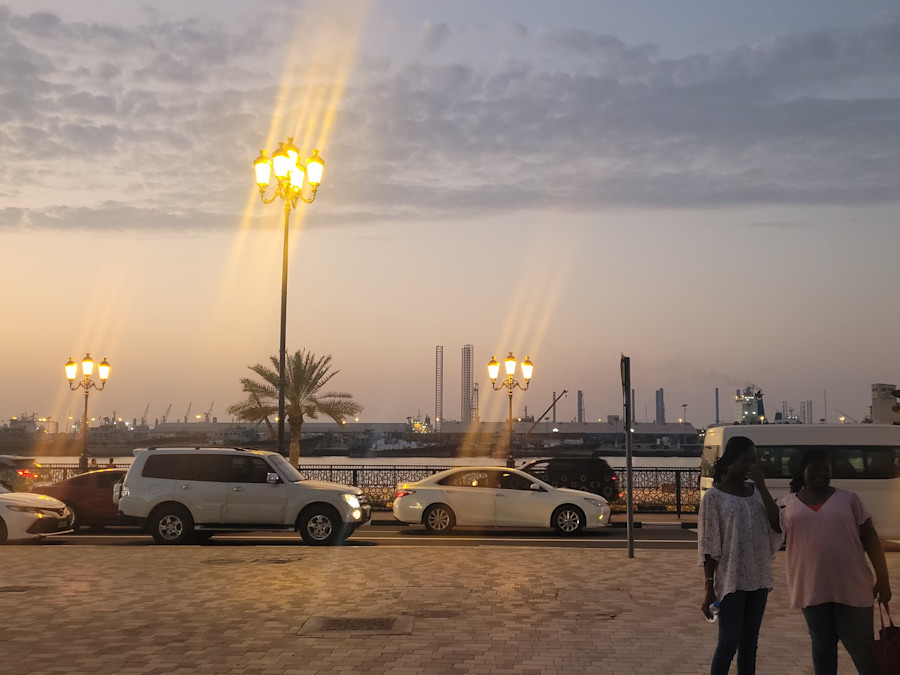
Earlier this year I spent six weeks in the UAE interning at Sharjah Art Foundation (SAF). Although this was daunting, when I reached the hotel I was too tired to feel nervous and the next day, my first day at the foundation, I was too busy to feel homesick.
Sharjah is the third biggest emirate and is in the middle of major developments, the sovereign ruler places great emphasis on tradition so old buildings are preserved and there are a range of buildings, designed in the 1970’s, that are being torn down to be redesigned in the traditional style. This creates an interesting looking city; half industrial and half traditional Islamic architecture.
March Meeting (MM)
March Meeting (MM) is an annual conference where artists, art practitioners and academics are invited to speak on a chosen topic, this year was The Post- Colonial Constellation. The event is free and attracts people from all over the world.
For this I helped set up the venue where MM took place, I helped with testing the mics, the projector and making sure all zoom links worked. I was also tasked with creating a time keeping sheet for the conference so that the panellists would know how much time they each had and in what order they would speak.
All of the talks were thought provoking, I learned about the issues faced by aboriginal people in New Zealand, the importance of archives and the challenge of sustainable architecture in East Asian countries etc. in essence, how people who were formerly colonised are reconstructing their personal identities, their cities and how this intersects with art production. But the most exciting part of MM was being able to interview the panellists. I planned out some questions but each interview turned into a conversation and became much richer than I had imagined. I spoke with Eddie Chambers, Zoe Whitley and Akeim Toussaint Buk, a performance artist. They’re of different generations and work in the art world in different capacities so it was interesting to learn about their experiences but also, despite their age difference, the glaring similarities between how they have been treated and how the art world continues to fail to engage different demographics.
Further, Hoor Al Qasimi, the director of SAF repurposes old buildings that are going to be demolished, uses them for the biennial and often relates the work in that building to its original purpose. One of the venues used to be a maternity ward so contained work pertaining to fertility, another venue which used to be a kindergarten housed work about children and education. I thought this was a great way to tap into the history of the emirate and it felt as though Hoor was saving buildings and gifting them back to the community to enjoy.
In relation to the biennial I worked on a manuscript. The Sharjah biennial began in 1993 and was orchestrated by the city until 2003 when SAF took it over. All of the publications for the first few biennials are in Arabic further, the city and SAF have different methods of documentation so information on previous biennials is tenuous. SAF want to streamline all of the information, so I was given some documents which detailed the publications and participating artists for each biennial and I worked with the library staff to collect information which would form the basis of a manuscript that would be a comprehensive guide to the Sharjah biennial from its inception until the present day. I also worked with other members of the publications team to help me translate the Arabic works. This manuscript is far from being complete but I loved this because I got to see how the biennial evolved to have an international focus placing emphasis on the MENASA region as well as the Caribbean and South America and how SAF gives a voice to the artists and academics who take part in the biennial through their publications.
SAF has grown a lot in a short space of time and is having conversations that I have not heard over here. I could tell that I was working somewhere great but any feelings of intimidation or imposter syndrome were squashed by how welcome I was made to feel and by the reassurance given to me by my peers. I did not fully appreciate until I got back, how important the SAF is.
University of Exeter
Room 153, Queen's Building
The Queen's Drive
Exeter EX4 4QH