This month we find out about a steel sculpture which provides ever-changing interest, as it reflects movement and light from its position high up on an exterior wall on the Streatham Campus.
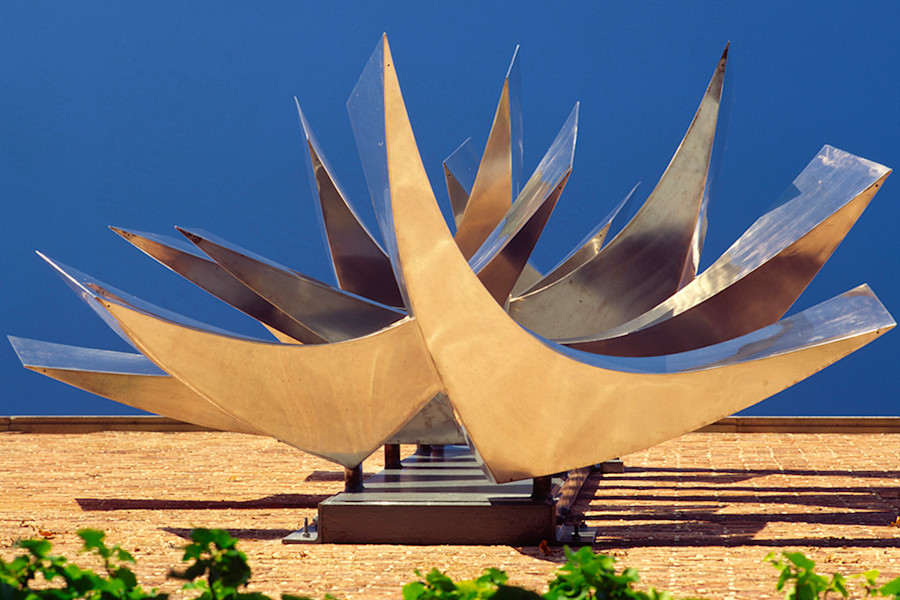
This month we feature a large stainless steel sculpture entitled Skysails, by South West sculptor Paul Mount (1922 - 2009).
About the sculpture
Skysails is a large wall-mounted sculpture, fashioned from stainless steel, by sculptor Paul Mount. It dates to 1974 and was obtained by the University in 1998. In the same way that a ship's sails catch the winds, Skysails picks up light, re-presenting it with its curved and polished steel surface. The constantly-changing reflections created by the sculpture bring it life and movement.
Whether the day is clouded or bright, Skysails asserts its compelling presence. In the evening light, the pink brick wall is reflected on the sails and, seen from immediately below the sculpture acquires a spiky effect, almost reminiscent of a ‘Tall Ship’ in full sail.
As a boy, Paul Mount was passionate about windjammers (sailing ships with multiple masts), an interest that was probably sparked by one of his grandfathers, who was a sailor. Below, you can see Skysails, as it is currently displayed, and alongside it is an image of a windjammer, which clearly shows the inspiration for the work.
About the Artist
Born in Newton Abbot, Devon, Paul Mount studied art at Paignton School of Art and later progressed to the Royal College of Art in London. After a break in his artistic career when he served as an ambulance drive during World War II, he taught at Winchester School of Art from 1848 and later in 1955 in Lagos, Nigeria, where he established an art department at Yaba Technical College.
Mount’s preferred artform was initially painting but whilst in Nigeria his interest in creating 3D forms was sparked by a wood-carver from Benin, whom he employed to teach the students marketable skills. Mount subsequently achieved success as a sculptor, gaining a number of commissions to create architectural features, including a relief on the wall of the Swiss Embassy in Lagos.
In the early 1960s he returned to the UK and moved to St Just in Cornwall where he focused on his practice as a sculptor for the remainder of his life, making his living from architectural and public commissions. As with other artists who resided in Cornwall, he was influenced by landscape, and he considered how his artworks would relate to the landscape in which they were going to be viewed.
Through his work, he often explored the nature of metals such as bronze, cast iron and steel, forming them into abstract forms. Sources of inspiration for the form of his works included music and motion, particularly of dancers. The sculptures often have a rhythmic and repetitive quality, bringing life and movement to the works.
Skysails can be seen on the University of Exeter's Sculpture Walk, which welcomes visitors from Monday to Friday. Read about the sculptures and download a map of the walk here.
University of Exeter
Room 153, Queen's Building
The Queen's Drive
Exeter EX4 4QH