A special exhibition of art in a variety of creative mediums by undergraduate nursing students at the University of Exeter. Each student has chosen a theme which has inspired their artwork. The display also reveals, through accompanying text, the creative learning journey of each student and how they feel their artwork may have impacted upon their own and wider nursing practice, perceptions, compassion and empathy.
Introduction
This fascinating exhibition was created by undergraduate nursing students for the module ‘The Art and History of Nursing’ at the University of Exeter.
Each student has explored a theme and created an artwork including painting, graphic medicine, collage, sculpture, creative writing and poetry.
The module has drawn on a range of literature, historical information and artistic mediums to help the nursing students understand more about nursing history and lived experience of health, illness and caring for others.
The students have explored how the creative arts may offer an outlet to express emotions and experiences which may be otherwise hard to understand or verbalise.
The exhibition explores each student's creative learning journey and how they feel their artwork may have impacted upon their own and wider nursing practice, perceptions, compassion and empathy.
Please note that the exhibition contains some challenging themes such as cancer, racism and abortion, which some might find distressing.
Watch a short film by BBC Spotlight to find out more about the purpose of this exhibition and see some of the contributors talk about their works.
Film: © BBC Spotlight
Theme: Historical Nursing Leaders
Challenges Inspire
by Fiona
Drawing and digital printing on paper.
Every nurse has the power to lead and inspire others. If you ask nurses why they decided on this career, many will attribute it to their personal experiences of nurses, which provided the motivation to follow in their footsteps. Nursing is not just a job, but it is an identity and an opportunity to do great things whilst inspiring the next generation.
This art piece follows three nurses who broke down racial barriers, transformed the healthcare industry and founded organisations that had a global influence in changing the course of nursing.
Florence Nightingale was born and raised in an era where women were expected to marry at a young age, and her parents were upset when she rejected a marriage proposal to take a job that was considered as lowly menial labour. Florence became one of the pioneers of rigorous handwashing, launched the first science-based nursing school, and created the Royal Commission for the Health of the Army. Florence was crucial in developing the nursing field, and inspiring others to follow in her footsteps.
Hazel W. Johnson-Brown was a Black woman who was refused admission to the local nursing school in Pennsylvania due to her race. Instead, she enlisted in the army, becoming a military nurse and earning multiple promotions. She became director of the Walter Reed Army Institute of Nursing and was chief nurse at an army hospital in Seoul, before being promoted to Brigadier General and Commander of the Army Nurse Corps. Hazel Johnson-Brown was the first Black woman to accomplish these titles and paved the way for future Black and Ethnic minority nurses to also achieve such feats.
Dame Elizabeth Anionwu was born to an Irish Catholic mother and Nigerian father, lived in numerous children’s homes, and faced physical and verbal abuse during childhood. Despite all of this, Elizabeth was the first UK sickle cell/thalassemia nurse specialist, founded the Mary Seacole Centre for Nursing Practice and was University’s Dean of the School of Adult Nursing Studies. She is an inspiration to many, including celebrities, with singer Dua Lipa paying tribute to her nursing career as she fought against racial injustice and advocated for frontline workers’ protection.
Nurses call to arms
by Lily Wolter
Poem with printed image on paper
This poem is called ‘Nurses call to arms’. Its aim is to inspire nurses to stand together against adversity and to be reminded of the courage and resilience they pose within their everyday duty as healthcare professionals.
The words are inspired by a British WW1 nurse called Edith Cavell. Edith was born in 1865 and in 1895 her father become seriously ill. It was her father’s sudden decline in health that encouraged her to become a nurse. During Edith’s inspiring career, she was appointed the first matron of Berkendael institute in Brussels, during which she oversaw the eduction of nurses. However, the start of WW1 led her to enlist her efforts in aiding injured British and allied soldiers. Edith helped approximately 175 men escape German occupied territory by nursing them back to health and providing them with false papers. Despite international pressure for mercy, Edith was sadly executed by the German firing squad in 1915 as her actions went directly against German military law.
Days before her execution, Edith wrote to her fellow nursing colleagues asking them not to be afraid and for them to remember her just as a nurse doing her duty.
It is the words written in Edith’s letters that strongly resonated with Lily, the same words used in this poem; ‘doing our duty’ and ‘patriotism is not enough’. Lily believes Edith’s desire to be recognised simply for her duty of care is admirable. Although her letters were written almost 100 years ago, Lily wanted her poem to highlight Edith’s words as they are a reminder for modern day nurses to not lose sight of their compassion for patient care. During the covid pandemic these same words and deeds were mirrored within the nursing fraternity every day, the selfless determination to care and the will to overcome situations that at times seemed insurmountable. Edith’s words will resonate with many nurses of today and act as a beacon of hope for the future.
Theme: End of Life and Palliative Care
What is important to you when you die?
by Francesca Rubke
Plaster sculpture
This artwork considers end of life care, specifically advance care planning (ACP). Through research, the artist discovered that there is a palpable comfort that can be felt in the patients being able to control the care they receive as they are dying.
This inspired student nurse Francesca Rubke to create a sculpture to represent the empowerment ACP brings for people in end-of-life care. The medium of clay provided a good medium for the expression of the artist’s ideas and allowed the idea of ‘taking your care into your own hands’, therefore supporting your dying self by planning aspects of your care that are important to you before you can no longer make these decisions. For example: deciding where you would like to be when you die, who you want involved in your care, and what kind of medications you would be open to having.
Through research, Francesca discovered that not many people are aware of what an ACP is, as not only do healthcare professionals sometimes avoid having these discussions with patients due to a lack of confidence in this area, but also due to the discomfort around discussing the topic of end-of-life care and particularly death. Instead, the ACP is often ignored in favour of other legal documents, such as a power of attorney, which despite entrusting the details of the patients’ care with somebody they trust, still does not allow the patient to have a say in their own care.
Through the research for making this artwork, the artist (a student nurse) has resolved to ensure that patients in her care will feel empowered even in such a difficult phase of their lives. She recognises the value of having this conversation with her patients and how important it is to put them at the centre of their own care; every individual and their values are different.
Theme: Women's Health
End-o the stigma
Anonymous artist
Mixed media, including a painted clay sculpture.
War on women
by Ellan Christophers
Paint on canvas.
Theme: Women's Health (abortion)
Judgemental hands
Anonymous artist
Mixed media
This sculpture is made from papier maché, medical gloves and hospital ID wristbands. NHS blue features in this work, referencing healthcare professionals, alongside the hospital ID bands and light blue scrubs. NHS identity guidelines show that the general public relate blue and white to the NHS and advise that the use of blue should be prominent.
This work aims to help reduce the stigmatisation that surrounds abortion. Healthcare professionals have an ethical duty to provide non-judgemental care for all their patients. As we are all human, we all have our own prejudices and thoughts surrounding subjects. The artist, a student nurse, has encountered women who have come into healthcare services, including GPs, seeking advice on where to go for an abortion who have been met with judgement from healthcare providers. These encounters inspired this work.
The use of the hospital ID bands in this sculpture aims to show the many different views on abortion across the world, and the many different reasons for a person to choose to have an abortion. The quotes on the hospital ID bands show some complex thoughts and judgments that surround the subject, including historical and cultural aspects such as different religious views. These quotes show to women that no matter their beliefs, culture, religion or background, healthcare professionals will assist with the right decision. Many women can feel apprehensive when seeking medical advice about their health, particularly around their reproductive system. Women can feel embarrassed and scared of receiving judgment from healthcare providers. In combination with this sculpture and education on women's healthcare, the artist hopes to reduce the stigma and promote trust between healthcare professionals and patients.
Historically, abortion and the portrayal of women’s healthcare across the years has had a dramatic impact on many women’s lives.
The last resort
by Ciara Slater
Mixed media
The termination of pregnancies using a coat hanger is sadly not a thing of the past. Millions of women worldwide are forced to terminate their pregnancies unsafely, as a last resort. This causes many complications and mortalities. Unfortunately, this is an issue that is just as prevalent now as it was many years ago, insufficient progress has been made. Many obstacles remain in the way of the facilitation of safe abortion such as financial instability and lack of funding for healthcare, the law and illegality of abortion, stigma and fear, public opinion and fear of judgement and religion. This results in many women feeling that they have no choice but to turn to terminating their pregnancies unsafely and risking their lives to do so.
The aim of this artwork was to depict the horrific reality that so many women endure worldwide. Student nurse Ciara Slater wanted to demonstrate the physical and emotional harm that occurs as a result of terminations that are unsafe, with the hope that awareness is raised about the reality of suffering of many women, as it is often denied or overlooked. Ciara states,
“I have come to the conclusion that in order for abortions to be done safely across the world, they need to be legal, funded and equipped with adequate healthcare facilities, professionals and equipment, and abortion must be accepted by everyone despite opinions or religions. Throughout this creative process, I have learned a lot about unsafe abortions and my eyes have been opened to how truly horrific and surprisingly common they are. I feel that this needs to be communicated to others in any way possible and hope that it is done so effectively, through my artwork. Unsafe abortions must stop.”
The Art and History of Women’s Choice
Anonymous artist
Paint on canvas.
Theme: Women's Health (infertility)
Hope
by Jami-Lee Dzharova
Mixed medium collage
Infertility is defined as the inability for an individual/couple to conceive a child after the duration of one year or longer, despite the engaging in regular unprotected sexual intercourse. It is estimated that approximately that one in eight couples within the United Kingdom are identified as being infertile.
The artist Jami-lee wanted to create a piece of art that allowed the viewer to take a glimpse into the world of infertility, to temporarily experience a small snapshot of the emotions, experiences, comments and dreams that those one in eight experience on a day-to-day basis and of their experience throughout the course of their treatment. By using raw materials such as needles, medication vials and hospital ID bands, the artist wanted to portray the harsh reality that many experience throughout this journey: emptiness, hurt and grief. The needles also reflect the physiological pain also associated with infertility.
The juxtaposition of using needles as flower stems comes from the concept of there being ‘No good without evil’. Whilst the flowers themselves are a representation of the flowers that bloom in the spring, a sign of new beginnings and new chapters.
Through communicating with several individuals, the Jami-lee gained insight into the different experiences many have encountered, particularly with healthcare professionals. For some this was positive and for others, a constant cycle of negativity. The petals in this work portray the difference in the positive experiences as well as the negatives. Every petal of colour is a representation of each and every healthcare professional, doctor, nurse, student and midwife who held their hands, who wiped the tears from their eyes and squealed with joy when all signs were pointing in the right direction. The quotations of ‘Warrior’, ‘I’ll hold your hand’ and ‘you are loved’ are the words that were softly spoken in the most vulnerable of moments to the individuals the artist communicated with. In contrast, the negativity and coldness of treatment has been portrayed in the form of decomposing petals - the words muttered by other healthcare professionals, doctors, nurses and midwives who over time have become dehumanised to the sensitive nature of their profession and who are primarily task focused.
Jami-lee’s intention for this work is to help others to feel able to speak out about their infertility, to encourage the topic to be discussed and the stigma to be swept away. Future nurses such as the artist and their peers will become aware of how simple words, actions and tasks can make the difference between a patient having a good experience or a bad experience. But most importantly, she hopes that this work will encourage each individual to not lose ‘Hope’.
Theme: Spirituality
Transitions
by Kirsty Cracknell
Acrylic paint on canvas
“When I’m out with him (the horse), it’s the only time I feel a connection to something bigger and more important than my life. I don’t believe in a god, but I know the world and nature will go on without me, that I am just part of a bigger force and I don’t know my place in it, but that I’m important, that my life, when I’m gone, mattered. That gives me a feeling of peace. That I can return to the force or energy - whatever that is. The joy of the wind, rain, sun and the changing seasons. It’s so quiet out there, just me and him. Time to think, to just be. Living until I die”
Whilst on placement with an oncology team, the artist Kirsty Cracknell, student nurse, spent a few days in a day-case chemotherapy unit. She met a patient, who she will call Jane, who was withdrawn and quiet, sitting apart from the other patients and either reading or scrolling her phone. Jane was younger than the other patients, and her diagnosis was stage IV cancer. As Kirsty sat with Jane, Jane started to tell her about the things that brought meaning to her life. The main theme of Jane’s words was transitioning through diagnosis and treatments. Kirsty also identified expressions of community and sense of belonging, feeling stigmatised and dehumanised, being a part of the natural world and humanity, valuing freedom, core beliefs and embracing the inner self.
This painting, in acrylics on canvas, challenges the audience to deeply consider Jane’s lived experience. The process of painting, the quiet contemplation and creativity, encouraged Kirsty to think deeply about the patient’s lived experience of her diagnosis and will influence her future practice by encouraging her to explore the words and symbols patients are using to communicate and to design interventions creatively and with critical contemplation and have a deeper understanding of spiritual distress at pivotal points in patient experience.
Providing spiritual care and comfort to patients has a long provenance within nursing, historically informed by the Christian beliefs. Developing innovative modules in nurse education will encourage keen observation skills and facilitate deep contemplation of patient spiritual needs that echo present day nursing ethics and professional codes. This will ensure that student nurses are confident in providing ethical, creative and compassionate responses to support patient spirituality and personhood.
Theme: Cancer
Us
by Lauren Bill
Poetry on paper, with mixed media including slate and Love in a Mist seed heads.
“Us” is an expression of the different perspectives of both a person living with their cancer and the cancer cell itself. The medium of poetry has been used to show the different feelings, emotions, and characteristics that each side has for one other. On the right side is the patient's perspective, talking to their cancer. It is very dark, whereas, the poem on the left hand side represents the cancer expressing its internal love towards the person. When the two poems are read together, parallel conversations are taking place without each other knowing. Through these poems, the reader witnesses a rarely seen side of the cancer.
The sculpture visually accentuates the two perspectives of the poems; the slate is split into two different sections one with a singular red cancer cell to represent love, how cancer feels towards humans and the other side a group of black multiplying cancer cells that cause the destruction commonly associated with cancer. The title is simple, to create the most impact; the rationale for using “Us” was to link the poems and as the poetry reveals almost secret conversations between the two of them,“Us” seemed the most appropriate.
Lauren, the artist states,
“This art piece can shed light on the relationship that cancer and humans have had with each other since we can remember and there may be another side of the story…
In the last 50 years, cancer has become a more prevalent factor in our everyday lives, yet we know so little apart from what it can do to individuals and families. Therefore, learning that cancer is something unique to every individual is something I wanted to show. Cancer for everyone is like their fingerprint so different to everyone else and so personal to that individual. That is why I wanted to display a conversation between the two to show the individuality between them and hope for people to see the learning that cancer is something we cannot always explain. That it just chose that person.”
Theme: Racism
Dear past, present and future
Anonymous artist
Mixed media
This artwork explores the historical and cultural aspects of racism in nursing and how it compares today.
Florence Nightingale springs to mind as an inspirational pioneer who sought great success in revolutionising nursing. Her prestigious upbringing landed her fully funded recruitment for the Crimea War. After her return, Florence received further public funding which enabled her to open her own training school. Mary Seacole is another nursing phenomenon, but her story is often left unheard. She was born in Jamaica and intended on joining Florence Nightingale’s team in Scutari. Despite her nursing experience during a Cholera epidemic, she faced rejection from both Florence and the British government and was left to fund her own travels. The nursing historiography reveals the concept of White privilege and how the experience and opportunities differ significantly dependant on race.
The collage follows a journey of racism and how it has changed over time. Despite the cultural and societal advancements that have occurred over time, racism still exists. Racism and oppression in the NHS leave nurses feeling ostracised and marginalised. Racist and oppressive behaviours are often left unchallenged which only promotes the acceptance of these behaviours in the workplace. Recent studies described the lack of team support as systemic neglect.
Structural changes are required to enforce change on a wider scale. Alongside global developments and the key element of the NHS long-term plan to improve equality, uniting the nursing community can be achieved through individual changes. Being more mindful, empowering, and supportive of colleagues who face discriminatory behaviours is a simple but powerful change to implement. As a result, nurses can contribute to an environment where equality, inclusivity and kindness is encouraged and celebrated.
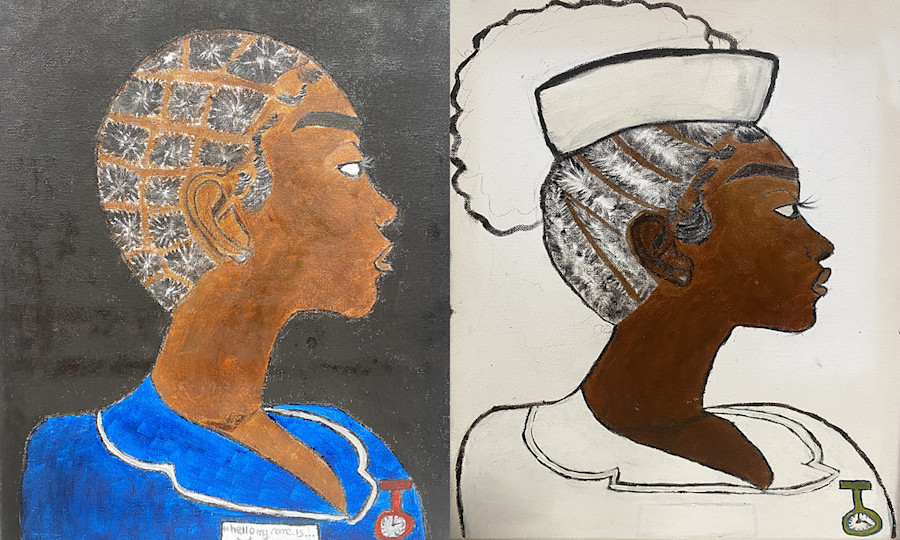
Detangling hairstory (history) in nursing
by Beatrice Ogbekhiulu
Mixed media
Afro hair has always had a distinct history that represents struggle while also celebrating survival and identity. Different hairstyles were traditionally worn to indicate marital status, religion, and wealth. Hair was also a symbol of spiritual power because some communities believe it is connected to the divine, as it is the most elevated part of the body.
Detangling hairstory in nursing aims to unpack hair discrimination and racism within the nursing profession, as well as the impacts. This is represented by nurses from both the 19th and 21st centuries. The 19th century nurse with the white uniform and hat represents a part of nursing history and was also used to represent people's misconceptions about Afro hair. Most people describe Afro hair as ‘nappy’, ‘unprofessional’, ‘dirty’, and ‘foamy’. The words on this portrait illustrate what Afro hair is not. Using a 19th century nurse to illustrate these misconceptions demonstrates that using these words, or any form of hair discrimination or racism, is archaic, and unacceptable.
This also suggests that certain policies within the nursing profession that intentionally discriminate against black nurses, particularly regarding their hair, should be reviewed. As an infection control protocol, nurses' hair should be kept above their collars and away from their faces in practice. Any other requirement that prohibits nurses from wearing their hair in locs, braids, puffs, or any other natural black hairstyle is simply racism disguised as regulatory policies. The broken combs and hair styling products in front of this portrait add to the impact of these words and how they can cause an individual to feel broken, lowering their self-esteem and confidence.
The 21st century nurse with the NHS uniform aims to celebrate the Afro hair by using affirmative words that genuinely represent what the Afro hair stands for. The Afro hair is professional, beautiful, versatile, and serves as our crown and identity. Using the modern nurse to celebrate the Afro hair, represents the beginning of a new dawn, and the abolition of archaic beliefs and discriminatory practices. Civilisation has brought about various means to enlighten and educate people, thereby no one can be expected to hide behind the veil of ignorance. The hair combs, clips, and hair extensions displayed in front of this portrait will demonstrate to the audience the products used to care for and adorn Afro hair and the styling process.
“Nursing is a graceful profession that provides care, respect, and compassion, why can’t the same grace and respect be extended to its nurses? The aim is to have a profession where people are accepted and their culture and being is respected regardless of their race or skin colour. Being accepting also involves considering nurses with Afros and braids when producing protective hair covers. And ensuring the establishment and implementation of accommodating policies and encouraging nurses to report racist and discriminatory practices.”
Theme: Military Nursing and Pain
War in Colour
by Ella Pammenter
Paper on board. Images created digitally using a tablet.
The theme of this creative piece is military nursing during World Wars I and II, chosen because it had a great impact on the nursing profession; more nurses were recruited and trained in new areas of nursing, and many worked on the front lines in WWII, which was previously discouraged.
Created by drawing on a digital software, this work focuses on pain in military nursing, representing both the nurse and the soldier. It is a type of ‘graphic medicine’, a field that explores and supports the interaction between the medium of comics and the discourse of healthcare. This medium was chosen because it is a unique type of art that helps to convey emotions and allows for the expression of individual opinions. The creative piece employs colour because it is uncommon to find genuine colour photographs from WWI or WWII. This allows the colours associated with military nursing to be seen and gain a better understanding of the nurses' and soldiers' perspectives.
The drawings portray different types of pain seen in military conflicts, but they also have aspects that apply to nursing today, representing pain felt by both a nurse and a patient. Pain is expressed in three ways: physical, spiritual, and psychological. Six scenes are portrayed, three from the perspective of a nurse and three from the perspective of a soldier. It also presents an idea of how soldiers saw nurses in the war, but also how nurses were seen throughout history.
The images convey the idea that the pain of a military nurse and a soldier are intertwined. When a soldier(patient) experiences one type of pain, a nurse may experience another type of pain. Implying it is important for nurses to be self-aware of their own pain when caring for a patient. This idea returns to the main point of the creative piece, which is that nurses experienced various types of pain as a result of their patients' pain. A patient's expression of pain is not limited to them; it can be intertwined and transferred to those around them. Furthermore, nurses have needed to help patients with pain throughout history, such as during war, but it has been a constant in nursing practice, to aid in patients' pain relief, whether physical, spiritual, or psychological.
The process of creating this artwork has given student nurse Ella empathy for the nurses during war and how they dealt with the intense pain around them; it has also given her the understanding to help improve how they assess patients' pain to ensure they are receiving holistic nursing care.
Watch a short film about how the physical version of this exhibition was developed.
University of Exeter
Room 153, Queen's Building
The Queen's Drive
Exeter EX4 4QH