An exhibition of photographs by Alan Puttock, taken from a suite of applied research at the University of Exeter seeking to increase understanding and maximise the benefits associated with the return of the Eurasian beaver to British landscapes.
Project Introduction
Eurasian beavers (Castor fiber) were once widespread and are now being reintroduced to an environment that has been intensely populated and modified by humans. As ecosystem engineers, beavers can dramatically modify ecosystems, notably this includes the creation of dams and complex wetlands. These wetlands bring a host of benefits for biodiversity and society. Our research has shown that beavers increase water storage and slow the flow downstream, meaning both reduced flood risk and increased water availability during drought periods.
In collaboration with Devon Wildlife Trust, landowners and a wide range of project partners the University of Exeter led research on the River Otter Beaver Trial. The trial was a five-year project (2015-2020) to investigate the effects of a wild-living population of beavers on the River Otter in East Devon. Beavers were released under a licence issued to the Devon Wildlife Trust – the first to be issued in England – and a detailed programme of research was undertaken and is available in our Science and Evidence Report.
The successful conclusion of the River Otter Beaver Trial contributed to beavers being granted European Protected Species status in England. Following the return of beavers to our landscapes, the Making Space for Water programme is now working with farmers and other land managers to build a network of nature-rich rivers and wetlands where beavers and other wildlife can flourish throughout South-West England. These networks will support the recovery of beavers, improve the health of our rivers and wetlands, and provide multiple other benefits for the environment and communities in Devon.
University of Exeter researchers are pioneering the use of novel technologies, mapping, modelling and monitoring to understand the environmental impacts of beavers, identifying where supporting beaver reintroduction can deliver the maximum benefits whilst minimising potential problems. Drone surveys are being undertaken to quantify wetland creation and provide evidence allowing landowners to receive support for enabling beaver ecosystem engineering. Further information on the project can be found here.
Renewed Coexistence
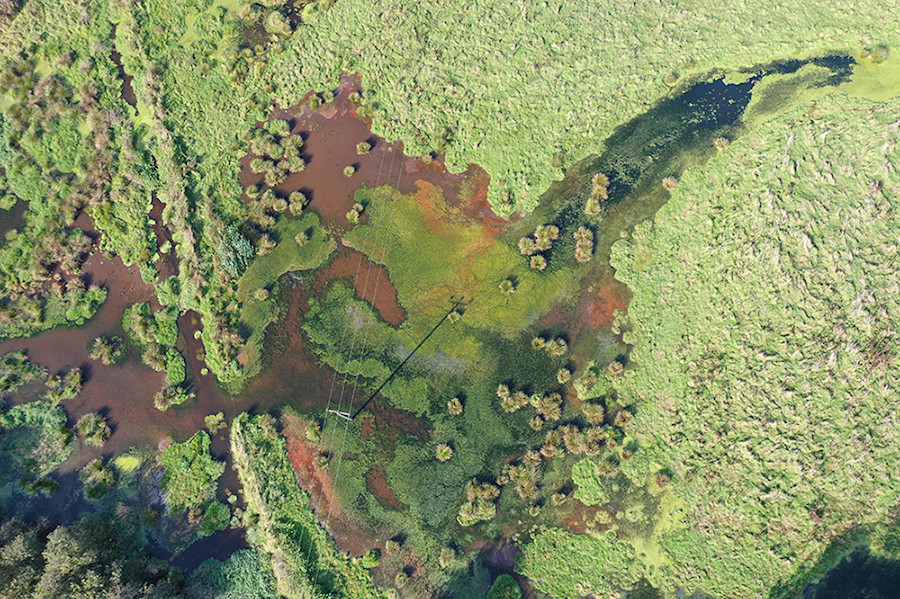
This aerial image from one of our study sites, summarises many of the considerations our research and the work of our project partners seeks to address. The image not only demonstrates the extensive wetland habitats beavers can create, but also serves as a visualisation of the conflicts and benefits of living with beaver. The expansive and complex wetland will benefit biodiversity and increase water storage within the landscape. The community downstream will benefit from flow attenuation, reduced flood risk, and increased drought resilience. However, this wetland creation by a non-human ecosystem engineer does represent a change to intensively managed landscape which may conflict with existing land use. Some farmland has been lost and local inundation may compromise infrastructure such as roads and farm tracks. Understanding these dynamics is critical to renewing our coexistence with this species.
The Hydrological Impacts of Beaver Engineering
At this study site owned by Clinton Devon Estates (https://clintondevon.com/) University of Exeter Researchers have been studying the hydrological impacts of beaver engineering, particularly dam building since 2017 as part of the River Otter Beaver Trial. Drone surveys show a tenfold increase in surface water at the site and several million litres of water being stored in the beaver ponds at any one time.
Changing Flow Regimes
Using water level and flow monitoring data from a downstream Environment Agency gauging station in addition to a gauging station on a nearby control site without beavers, researchers were able to look at how downstream flow regimes were changing because of beaver activity. Results from this BACI (Before-After-Control-Impact) experiment showed significant reductions in storm flows downstream by up to 30 percent, reducing flood risk to the village of East Budleigh. This work was undertaken alongside monitoring of multiple other sites across Britain with the published study accessible via the link below.
Average reductions in peak stream flows during storm events of circa 30 percent indicate beavers could play a valuable part in contributing to flood management strategies.
See research article Beaver dams attenuate flow: A multi-site study (Hugh A. Graham, Josie Ashe, David J. Luscombe, Richard E. Brazier) here.
Slowing the Flow
This beaver reintroduction site also played a key part in developing our conceptual understanding of how and why beaver wetlands reduce storm peaks downstream, even during large storm events. Beaver dams and the associated ponds increase water storage within the landscape, whilst also increasing connectivity with the floodplain, pushing water sideways creating additional transient water storage capacity during storms. Compared to many of our intensively managed landscapes, beaver wetlands also create a ‘rough’ landscape for water to travel through, achieving the ‘slowing the flow’ effect desirable in natural flood management projects.
These concepts are explored further in a paper led by Dr Hugh Graham as part of his PhD research during the River Otter Beaver Trial.
Increasing Resilience
Whilst in Britain with its notoriously wet weather we are often focused on the risks of flooding, the other hydrological extreme of drought is increasing in prominence. Both drought and flooding are predicted to increase in severity and regularity with climate change.
By creating water storage in wetlands throughout the landscape and maintaining downstream flow during dry periods we may be able to increase our resilience to future climatic extremes. This image from is from a site in the River Otter catchment.
Water Quality Benefits
At another site within mid-Devon, in addition to the water storage and flood peak reduction benefits of beaver wetlands, scientific monitoring also showed beavers to be delivering water quality benefits. The 13 ponds at this site were shown to trap and store over 100 tonnes of sediment and associated carbon, as suspended solid rich water entering the site from farmland upstream was slowed and filtered.
During storms when diffuse water pollution from agriculture is typically greatest, water leaving the site was shown to have on average 3 times less suspended solids, as well as lower phosphate and nitrogen concentrations compared to water entering the site.
For more information about the research, click here. (Alan Puttock, Hugh A. Graham, Andrew M. Cunliffe, Mark Elliott, Richard E. Brazier)
A Mosaic of Habitats
Beavers as a keystone species are a species that has a disproportionately large effect on its natural environment relative to its abundance. It is well recognised that the engineering activities of beaver create a mosaic of habitats that support biodiversity by creating habitat for a whole host of other species. Looking closely at this aerial image of a beaver wetland in Devon, multiple bird species can be made out which have made a home at this site.
Biodiversity benefits
The biodiversity benefits of beavers can include other mammal species. As part of the River Otter Beaver Trial, free-living beavers were reintroduced into a County Wildlife Site where water voles were also present and being surveyed.
Water voles (Arvicola amphibius) are native to much of Europe, but in Great Britain they are critically endangered with populations thought to have declined by over 90 percent since the 1970s.
Creating New Habitat
Survey data at this site showed a rapid expansion in wetland following beaver reintroduction and the expansion of water vole into newly beaver engineered wetland areas. We propose that complex beaver wetlands may benefit water vole populations by creating new habitat and providing refuge from predation.
This study can be accessed here.
A Challenge to our Perceptions
Our research has shown that the beavers can thrive in the modern British landscapes they are returning to and can deliver multiple nature-based solutions. However, it is critical not to overlook that the return of beaver will bring management issues, conflict with existing land use and challenge our perceptions of what a landscape should look like.
At the University of Exeter, Dr Roger Auster has been leading a suite of research into the human dimensions of Eurasian beaver reintroduction in Britain including studies of potential opportunities, conflicts, and societal views of beaver reintroduction and management. Further information on Roger’s research can be found here.
Researching Beaver Impact
In 2020 to bring together our beaver research undertaken at the University of Exeter in a group led by Professor Richard Brazier, a review was written, summarising how beaver impact: (a) ecosystem structure and geomorphology, (b) hydrology and water resources, (c) water quality, (d) freshwater ecology, and (e) humans and society. It concludes by examining future considerations that may need to be resolved as beavers further expand in the northern hemisphere with an emphasis upon the ecosystem services that they can provide and the associated management that will be necessary to maximize the benefits and minimize conflicts.
Read the review here.
Making Space for Water
Now beavers have returned to Britain, we continue working with project partners to inform management and policy aimed at ensuring beaver reintroduction is sustainable. The Making Space for Water programme, led by Devon Wildlife Trust aims to bring together businesses and other organisations who benefit from beavers to provide financial support which rewards farmers and other land managers who make space for beavers on their land.
Realising the benefits of beaver-created dams and wetlands relies on the capacity to make space for wetlands in the landscape. This sometimes requires a transition in land use and land managers need support to achieve this change. This image comes from a drone survey taken to quantify wetland creation and provide evidence allowing landowners to receive support for enabling beaver ecosystem engineering.
Measuring environmental benefits
Working in partnership with the University of Exeter, Devon Wildlife Trust are using innovative spatial maps, models and survey approaches to target financial support for land managers in areas where making space for beavers will deliver measurable environmental benefits, including natural flood management, water quality enhancement and increased biodiversity.
In these image Dr Holly Barclay and Dr Matt Holden from Devon Wildlife supervise a drone survey to map beaver wetland extent.
Further details of this project can be found here.
Education, Outreach and Engagement
Education, outreach and engagement are vital components of our activities, and nothing beats getting stakeholders and project partners out to field sites and showing them the fascinating ecosystems beavers engineer, both from the ground and air. In these images groups can be seen touring beaver sites with University of Exeter researchers.
A recent event that included a major field trip component was the 2023 Beaver Conference co-hosted by Beaver Trust, Devon Wildlife Trust and University of Exeter. This conference on the theme of restoring beavers to the British landscape, brought together researchers, policy makers and practitioners to share state of the art understanding. Resources from this conference can be found on the Beaver Trust website here.
Dr Alan Puttock
Alan is an environmental scientist and ecohydrologist specialising in nature-based solutions, natural flood management, species reintroduction and landscape restoration.
Alan actively seeks to undertake interdisciplinary applied research in collaboration with a wide range of project partners to ensure research has both academic and non-academic impact.
Since 2014 a particular focus has been studying the reintroduction of the beaver, seeking to provide understanding which maximises the benefits and minimises the conflicts associated with the return of these ecosystem engineers to our landscapes.
Alan is currently a Lecturer in Geography at the University of Exeter. Further information on Alan’s research can be found here.
Alan seeks to make all his research open access and a full list of his published work can be found at the link below. If any problems accessing or for more information he can be contacted at: a.k.puttock@exeter.ac.uk.
Click here for Alan's Google scholar bibliography.
Further updates and imagery from his fieldwork can be found at: https://twitter.com/AlanPuttock
Alan Puttock undertaking a survey of a beaver wetland
“I’m fortunate to work across a fantastic range of landscapes where project partners are undertaking pioneering work to implement nature-based solutions tackling the critical environmental problems we face.
A key example of this has been the reintroduction of the beaver, a native species which as an ecosystem engineer can dramatically alter landscapes. Visualising these landscape changes and communicating them to stakeholders and the public is critical. New technologies such as drones have provided innovative tools for doing this.”
University of Exeter
Room 153, Queen's Building
The Queen's Drive
Exeter EX4 4QH