An exciting online photography exhibition showcasing the research and people behind the University of Exeter’s highly interdisciplinary approach to tackling the urgent global health threat of antimicrobial resistance.
University of Exeter AMR Network – Researching Resistance
About the exhibition
This online exhibition Researching Resistance aims to showcase and celebrate the diverse range of people and approaches used to tackle this issue within our Antimicrobial Resistance (AMR) network. We invited fifteen members across different research areas and career levels to demonstrate that AMR is an issue that goes beyond disciplinary, societal and national boundaries.
The fifteen researchers featured worked with the artist Simon Ryder to identify elements of their work that were important to them and their AMR interests.
Despite the challenges of the COVID pandemic, Simon managed to photograph them all, either at home, at their place of work or at their favourite location.
The relationship between Simon Ryder and Exeter’s AMR network began in July 2020, when he was awarded a Creative Fellowship to work with Dr Kelly Thornber at the Wellcome Centre for Cultures and Environments of Health. The Creative Fellowship is an annual programme, funded by the University’s Arts and Culture Team, which brings together creative practitioners and academic researchers for mutually beneficial dialogue and exchange of ideas. Simon spent the year integrating into and engaging with the network.
We welcome everyone to join our AMR network, whatever your research interests or role in society. For more information, please see our webpages, or contact AMR-Network@exeter.ac.uk.
About Antimicrobial Resistance (AMR)
Antimicrobial resistance, or AMR, is an issue developing on a global scale. Microbes that cause infectious diseases in humans, animals and plants (also known as ‘superbugs’) are becoming increasingly resistant to the drugs we currently use to treat them.
"AMR is the silent pandemic growing in the shadows.”
The World Health Organization predicts that, by 2050, some 10 million deaths each year will be caused by infectious diseases that could previously have been treated by antimicrobial drugs such as antibiotics, antivirals, antifungals and antiparasitic medicines. Despite substantial global effort, there has been little progress in the development of new antimicrobial drugs for over 30 years.
“AMR poses a serious threat to the entire world…solving it will require urgent, concerted multi-sectoral action”
AMR is not just a medical problem. It’s also a significant risk to food security and threatens to undermine progress towards many of the other sustainable development goals. The solutions are not simple, requiring a collaborative, multidisciplinary response across a broad range of interlinking, yet often disparate, national and global communities.
To achieve this, a truly interdisciplinary approach is needed. The University of Exeter’s AMR network brings together social scientists and humanities specialists with microbiologists, mathematicians and many more. Our members come from academia, industry, the UK Government and beyond. We hope that by working together we can more quickly and effectively realise the societal change that is desperately required.
About the artist
Simon Ryder is an investigative artist working across a broad range of media. He has a particular interest in places, landscapes and their communities. This has evolved in recent years from exploring the physical spaces around us to the imaginative places and landscapes that we all carry within us.
Since graduating from the Royal College of Art, he has created artworks nationally, including for the Cultural Olympiad, the National Trust, NHS and universities. This particular commission grew out of a Creative Fellowship that he held with the University of Exeter Antimicrobial Resistance Network in 2020/21.
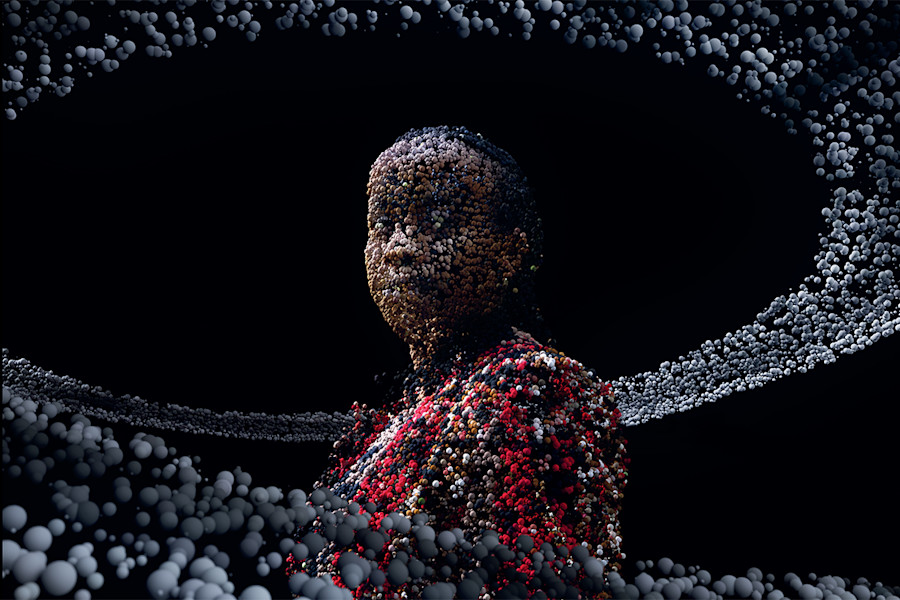
"I was looking for a way of blending academics and their work into an overall portrait of the AMR network, to show the diversity of people and research being undertaken in this important field. I chose to do this using the medium of point clouds, atomising everything to a 3D mass of dots that you can imagine flowing between images, mixing and reforming, a single mass of resistance."
The portraits use photogrammetry to create a series of point clouds which, with the help of creative technologist Nathanial Mason were then manipulated in 3D animation software to produce the tableaux that you see above.
Watch an interview with Simon in which he shares more about his creative process, motivations and thoughts behind the exhibition.
With thanks to...
This exhibition has been made possible thanks to an original award from the Provost’s Fund to establish a University of Exeter AMR Network and generous assistance from the MRC Centre for Medical Mycology.
It built upon a Creative Fellowship that took place in the 2020/21 academic year, which was funded by the University’s Arts & Culture Team and hosted by the Wellcome Centre for Cultures and Environments of Health.
"The University of Exeter’s AMR Network would like to thank all of the researchers who gave up their time to be photographed and also Emma Lamb, Katya Romankevich and Dr Kelly Thornber for their work behind the scenes on the coordination of this exhibition."
Dr Demelza Curnow, AMR Network Co-ordinator
University of Exeter
Room 153, Queen's Building
The Queen's Drive
Exeter EX4 4QH