An exhibition of photographs by Tara Nicholson and Corinna Wagner, which witnesses the complex obstacles caused by environmental destruction and urges us to recalibrate our activity on this planet.
Introduction
Wicked Problems: The Humanities in an Age of Planetary Agenda-Setting brings together the work of Canadian artist/PhD candidate Tara Nicholson and photographer/Exeter Professor Corinna Wagner, as part of an ongoing collaboration between the Universities of Exeter and British Columbia Okanagan.
A ‘wicked problem’ is a difficult or seemingly impossible obstacle with no single solution due to its social complexity. We ask how creative artists and practitioners, as well as Humanities researchers, might engage with and open up ways of addressing wicked problems.
Through photography and installation Nicholson and Wagner make images that go beyond the act of witnessing. They utilise interdisciplinary research that includes storytelling, image-making, and oral testimony to tell more-than-human stories in a time of climate crisis. The work encourages empathic attention to layers of destruction, during what has been described as the sixth mass extinction — the first caused by human activity.
Nicholson’s Arctic landscapes challenge us to act now, to stop rapid loss of biodiversity, while Wagner’s ruined landscapes reveal our ‘abandoned futures’ in order to suggest new ways of conserving and regenerating.
This joint project connects with a growing collective of scientists, activists, traditional knowledge holders, filmmakers, artists and writers, who are dedicated to decolonial, eco-feminist and more-than-human ways of being. Collaboration is urgently needed to recalibrate our activity on this planet.
The exhibition is part of a UBC Okanagan-Exeter Excellence Catalyst Grant (Ina Linge, Paul Young, Jodey Castricano) awarded for a project entitled 'Telling Stories' which explores how humanities research can engage with the opportunities and challenges posed by planetary agenda-setting and the global challenges they confront. See illustrations visualising themes discussed in the project's symposium in May 2023 here.
Tara Nicholson
Tara Nicholson is an artist and PhD candidate who explores ecological activism through a more-than-human lens. She has exhibited across Canada while receiving funding from the BC Arts Council and Canada Council. She attended ‘Earthed’ an international eco-art residency at the Banff Centre and was awarded the Künstlerhaus Dortmund Artist-in-Residence Award. Since 2013, she has taught at the University of Victoria and holds degrees from Ryerson University and Concordia University. Recently, she presented at the “Animals & Landscapes" Symposium (Liverpool) will be part of two upcoming surveys on contemporary photography at the Victoria Arts Council (BC) and Gallery 44 (Toronto).
PhD Project
Nicholson’s photo-based research engages the Arctic as a landscape of rapid change and future possibility in an effort to produce a greater dialogue between western scientific knowledge and the production of art. Her research aims to create a wider understanding of Arctic extinction studies encompassing migration monitoring, rewilding, breeding trials and more speculative (de)extinction schemes that involve gene cloning and vivisection. Her work considers the intensifying value of the ‘frozen’ connected to scientific and cultural narratives and the bleak realities attached to extinction studies.
https://www.criticalanimalstudies.ok.ubc.ca/
https://ecocene.kapadokya.edu.tr/index.php/ecocene/article/view/85/82
Outpost Buildings, Pleistocene Park, Sakha Republic, Russia
River Test Site, Northeast Science Station, Russia
Lab, Arctic Station, Qeqertarsuaq, Greenland
Left: Exposed Permafrost Samples, Duvannyi Yar, Sakha Republic, Russia
Right: Water Test Site, Northeast Science Station, Russia
Permafrost Monitoring, Aurora Research Institute, Northwest Territories, Canada
Ilulissat Harbour, Greenland
Moose Rescue, Pleistocene Park, Sakha Republic, Russia
Skatepark, Qeqertarsuaq, Greenland
Sunrise, Arctic Ocean, Northwest Territories, Canada
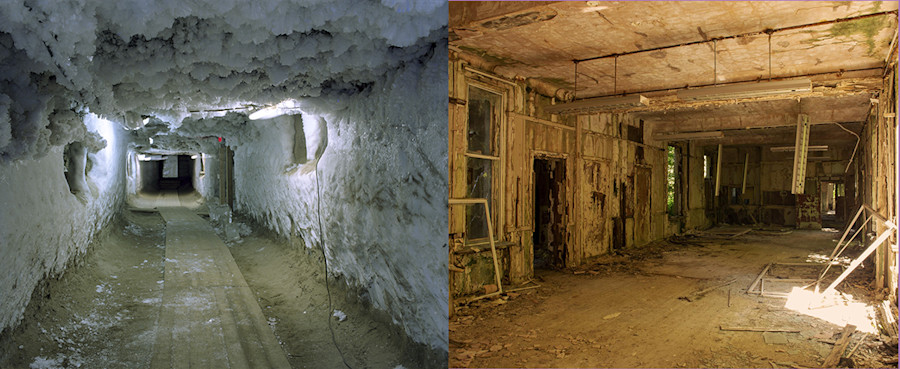
Permafrost Research Tunnel, Melnikov Permafrost Institute, Yakutsk, Russia
Wild Horses, Pleistocene Park, Sakha Republic, Russia
Field Work, Arctic Station, Qeqertarsuaq, Greenland
Water Samples, Lyngmark Glacier, Arctic Station, Qeqertarsuaq, Greenland
Scientist, Permafrost Samples, Duvannyi Yar, Northeast Science Station, Sakha Republic Russia
Exposed Permafrost Samples, Duvannyi Yar, Northeast Science Station, Sakha Republic Russia
Permafrost Measurements, Lake site, Northeast Science Station, Sakha Republic Russia
Northeast Science Station (former Radio Station), Sakha Republic Russia
Northeast Science Station, Sakha Republic, Russia
Corinna Wagner
Corinna Wagner is Professor of Visual and Literary Arts, University of Exeter. Her work combines image and text, especially photography, poetry and creative non-fiction. She employs arts-based approaches to investigate relationships between bodies—human and animal—and built and natural environments. Current publications and exhibitions focus on ruin, loss, and rewilding during a time of accelerated climate change. Her recent project, Time and Tide: Resilience, Adaptation, Art was supported by the UK Climate Resilience Programme and the Natural Environment Research Council (NERC). A solo exhibition Corinna Wagner: TerraOceanus, will run 17 June to 12 August, 2023 at the Thelma Hulbert Gallery, Honiton.
Current Project
Wagner’s series ‘Reading Ruins’ is a meditation on a past that doesn’t stay dead. We know this as much from gothic literature as the ‘zombie’ waste—long-buried plastics—that reappear on beaches after decades of burial. Ruins are entangled materialities, unions of culture and nature, places of memory and imagination that point from past to future. They unmask cherished illusions about accumulation and progress. They ask us to redress histories of land dispossession, to resist the priorities of global development, and to break cycles of environmental and social exploitation. Keeping with her theme, Wagner works with sustainable materials such as caffenol, mulberry paper, and beeswax.
Asylum 2, 2020
God, 2020
Gone, 2020
Crown of Thorns, 2020
Bromide Plant 1, 2021
Bromide Plant 2, 2021
Bromide Plant 3, 2021
Bromide Plant 4, 2021
Death of Welsh Mining, 2021
Capel, 2020
Gare, 2022
End of British Steel 1, 2022
Red Dress Manor, 2020
Left: Slow Ruin, 2020
Right: Pier 2, 2020
Room, 2021
Burn, 2021
Lake Fire 1, 2021
Government Arson, 2021
University of Exeter
Room 153, Queen's Building
The Queen's Drive
Exeter EX4 4QH